I’m sitting in Washington, D.C. today, preparing to meet with lawmakers from the Senate and the House, and one thing is crystal clear:
America’s innovation economy runs on ideas. But having a great idea is only half the battle.
The real question is:
How do you protect it?
Whether you’re an entrepreneur, software developer, artist, startup founder, author, inventor, content creator, or business owner, understanding the difference between Copyright, Trademark, and Patent isn’t optional, it’s essential.
These three forms of intellectual property protection are often confused, sometimes used interchangeably, and frequently misunderstood.
They shouldn’t be.
Because choosing the wrong protection, or no protection at all, can cost you your competitive advantage, your revenue, and in some cases, ownership of what you created.
So let’s break it down.
1. Copyright: Protecting Creative Expression
When people hear “intellectual property,” copyright is usually the first thing that comes to mind.
A copyright protects original creative works that are fixed in a tangible form.
That includes:
- Books and articles
- Blog posts
- Music and lyrics
- Videos and podcasts
- Photography
- Artwork and graphics
- Movies and screenplays
- Software code
- Training materials
- Presentations
- Website content
In other words:
Copyright protects how you express an idea, not the idea itself.
If you write a book about AI agents, copyright protects your words, your structure, your diagrams, your code examples.
It does not prevent someone else from writing their own book about AI agents.
When does copyright begin?
This surprises many people:
In the United States, copyright protection begins the moment your original work is created and fixed in a tangible medium.
That means:
- Saved on your laptop
- Written on paper
- Recorded on video
- Stored in the cloud
Registration is not required for ownership.
However…
Registration with the United States Copyright Office gives you powerful legal advantages, including the ability to bring infringement lawsuits and potentially recover statutory damages.
Current state in the U.S.
Today, copyright law is facing intense pressure from:
- Generative AI training
- Synthetic content
- Ownership of AI-assisted creations
- Digital piracy
- Social media redistribution
Major questions being debated right now include:
- Can AI-generated works be copyrighted?
- Is training AI on copyrighted content “fair use”?
- Who owns human-plus-AI creations?
The law is evolving fast. And lawmakers in Washington know it.
2. Trademark: Protecting Your Brand Identity
If copyright protects creativity…
Trademark protects identity.
A trademark protects the symbols that tell the market:
“This product or service comes from me.”
That includes:
- Business names
- Product names
- Logos
- Slogans
- Taglines
- Distinctive packaging
- Brand colors (in some cases)
- Sounds (yes, even sounds)
Think about names like:
- Apple
- Nike
- Coca-Cola
Those names instantly communicate trust, quality, and reputation.
That’s trademark power.
When should you use a trademark?
The moment you launch:
- A company
- A product
- A course
- A consulting brand
- A podcast
- A software platform
If people will associate a name with your reputation…
Trademark matters.
Current state in the U.S.
Trademark law in America remains strong, but businesses are facing new challenges:
- Domain name conflicts
- Social media impersonation
- Marketplace counterfeiting
- International copycats
- AI-generated branding collisions
The United States Patent and Trademark Office continues modernizing digital filing and enforcement, but brand owners still need to actively monitor misuse.
Because trademarks aren’t “set it and forget it.”
If you don’t defend your mark… You can weaken it.
3. Patent: Protecting Inventions and Innovation
Now we get to the heavyweight.
A patent protects new, useful, and non-obvious inventions.
This includes:
- Machines
- Manufacturing processes
- Chemical compositions
- Medical devices
- Electronics
- Software-based inventions (in some cases)
- Industrial processes
- Hardware innovations
In plain English:
If you invented something the world has never seen before…
Patent may be your strongest protection.
Types of patents in the U.S.
Utility Patents
- The most common.
- Protect how something works.
Design Patents
Protect how something looks.
Plant Patents
Protect new plant varieties.
Yes… plants.
When should you file?
As early as possible.
The U.S. operates under a “first inventor to file” system.
That means speed matters.
Talking publicly about your invention before filing can create serious complications.
Current state in the U.S.
Patent law today is navigating:
- AI-generated inventions
- Software patent eligibility
- Semiconductor innovation
- Biotechnology acceleration
- Global competition with China and other innovation economies
One of the hottest legal debates:
Can an AI system be listed as an inventor?
Right now in the United States:
The answer is NO.
Inventorship currently requires a human.
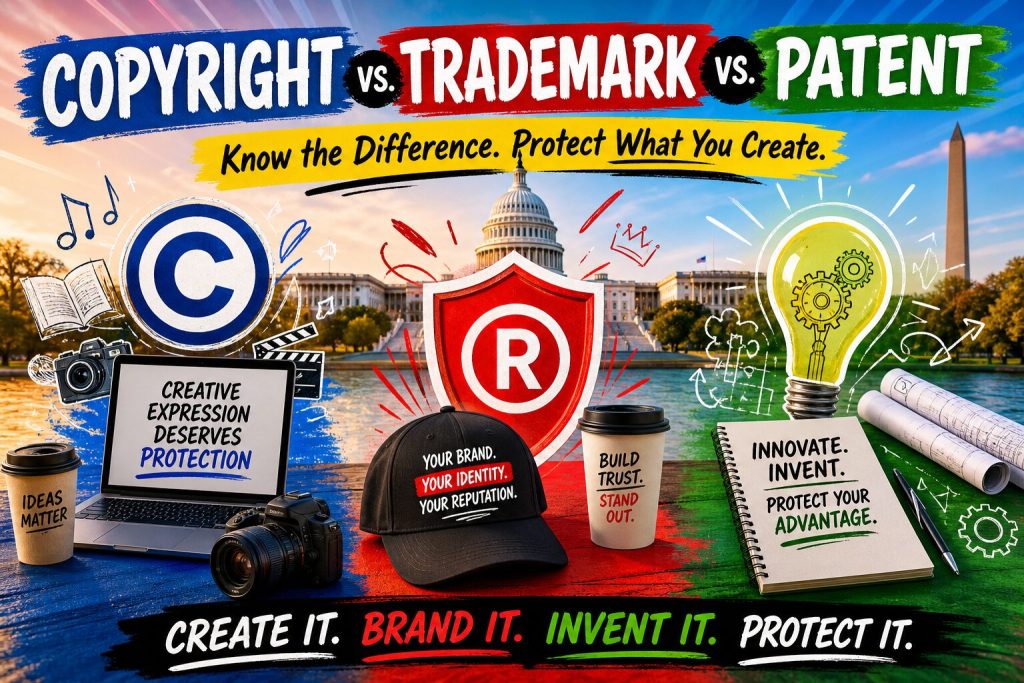
The Simplest Way to Remember It
If you create it…
Copyright.
If you brand it…
Trademark.
If you invent it…
Patent.
Or even simpler:
- Words, music, code, content → Copyright
- Names, logos, slogans, reputation → Trademark
- Products, processes, inventions, technology → Patent
The Reality in 2026: AI Is Changing Everything
We are entering a new era where creators, founders, and innovators are asking entirely new questions:
- Who owns AI-generated content?
- Can an AI-designed product be patented?
- Can an AI-generated logo be trademarked?
- How do we protect human creativity in a machine-assisted world?
These aren’t future questions.
These are Washington questions.
Right now.
And as I sit here in our nation’s capital preparing to engage with policymakers, one message has never been more important:
Innovation without protection is exposure.
If you create…
Protect it.
If you build…
Protect it.
If you brand…
Protect it.
Because in today’s economy, your ideas may be your most valuable asset.