
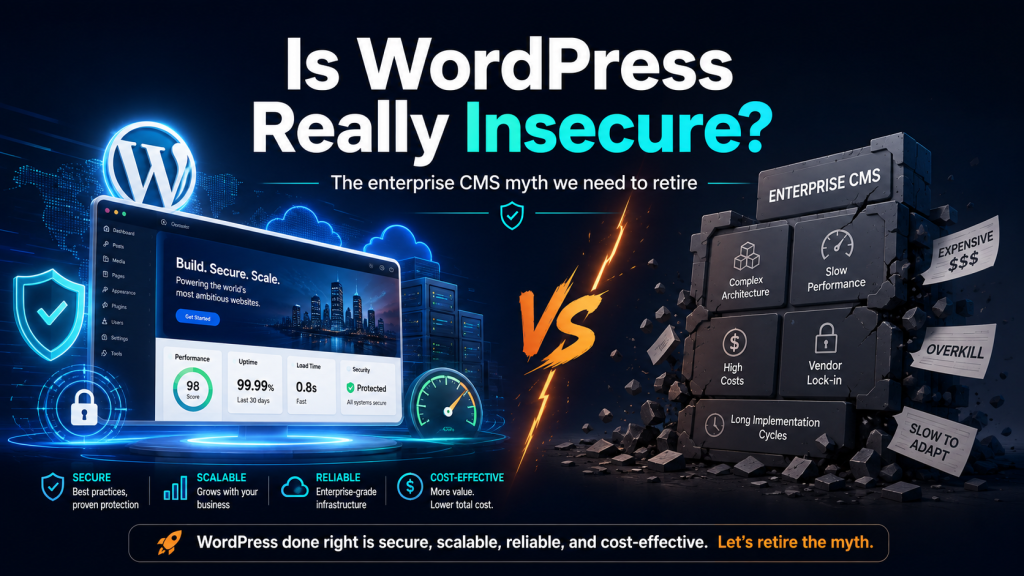
The Enterprise CMS Myth We Need to Retire
For years, I’ve heard essentially the same argument from the enterprise CMS world:
“WordPress is fine for blogs and small websites, but serious enterprises need something more secure, scalable, and reliable.”
Usually, that “something” happens to be the CMS platform being sold.
- Sitecore.
- Progress Sitefinity.
- Kentico.
- And plenty of others.
Having worked extensively with Sitefinity, Kentico, Sitecore, and WordPress, I’ve always found this argument a little frustrating.
Not because those enterprise platforms are bad products. They aren’t. They are powerful systems with legitimate enterprise capabilities.
The problem is the assumption that WordPress is somehow inherently inferior simply because it is open source, inexpensive, enormously popular, and supported by a huge plugin ecosystem.
That conclusion doesn’t hold up very well once you look at the evidence.
So let’s separate the marketing from the engineering.
WordPress Is Everywhere, and That Changes the Conversation
Before discussing security, consider the sheer scale of WordPress.
According to W3Techs, WordPress powers roughly four out of every ten websites on the Internet and close to 60% of websites using a known content management system.
Think about that for a moment. WordPress isn’t some niche blogging platform anymore. It is one of the most widely deployed software platforms on Earth. And that popularity creates an interesting side effect:
Attackers love WordPress too.
If you discover an exploit affecting a technology deployed on millions upon millions of websites, you potentially have an enormous target population.
That means security researchers investigate WordPress heavily.
Attackers investigate WordPress heavily.
Automated bots scan WordPress heavily.
Security companies monitor WordPress heavily.
So when someone says:
“WordPress gets attacked constantly!”
My response is:
Of course it does. So does Windows. So does Microsoft 365. So does Azure. So does every massively deployed technology platform.
The number of attacks against a technology is not the same thing as the quality of that technology’s security architecture.
Popularity creates opportunity.
The Statistic That Changes the WordPress Security Conversation
Here is where things get very interesting. Patchstack’s State of WordPress Security in 2026 identified:
11,334 new WordPress ecosystem vulnerabilities during 2025.
That number sounds terrifying.
And if we stopped right there, it would make a fantastic enterprise CMS sales slide:
“More than 11,000 WordPress vulnerabilities!”
Cue dramatic music.
Except that isn’t the whole story.
Of those vulnerabilities:
- 91% were found in plugins
- 9% were found in themes
- Only six vulnerabilities were attributed to WordPress core
And those WordPress core vulnerabilities were classified as low priority. That distinction is enormous.
When we casually say:
“WordPress has thousands of vulnerabilities,”
what we usually mean is:
“Thousands of vulnerabilities exist across the enormous ecosystem of independently developed software that can run on WordPress.”
Those are not the same statement. Not even close.
WordPress Core Is Not the Same Thing as the WordPress Ecosystem
This is probably the most important distinction in the entire debate. When people talk about “WordPress,” they frequently combine three completely different things:
- WordPress Core
- Themes
- Plugins
But from a security perspective, those need to be treated separately.
WordPress core is maintained through a mature open-source development and security process.
Plugins, on the other hand, can come from almost anywhere.
They might be developed by:
- Automattic
- Elementor
- Yoast
- WooCommerce
- a major software company
- an experienced independent developer
- a tiny development shop
- someone working on a side project
- or a developer who abandoned the project three years ago
And therein lies the real WordPress security challenge. It isn’t necessarily WordPress. It’s governance.
The Plugin Problem Is Real
Now, I don’t want to swing the pendulum too far in the other direction.
Saying:
“WordPress core is secure, therefore WordPress security isn’t a problem.”
would also be misleading.
Plugins matter. A lot.
If a vulnerable plugin allows an attacker to upload arbitrary files, escalate privileges, execute SQL injection, or take control of your site, it doesn’t really matter to the business owner whether the vulnerability technically originated in WordPress core.
The website was compromised. That’s the reality.
And this is where Sitecore, Kentico, Sitefinity and other integrated enterprise platforms have a legitimate argument.
A more integrated platform can potentially reduce the number of independent software suppliers involved in delivering functionality.
Instead of installing separate plugins for:
forms, personalization, workflow, analytics, search, marketing automation, security, SEO, and integrations, an enterprise DXP may provide many of those capabilities within one product.
That means fewer vendors. Fewer update channels. Fewer dependencies. Fewer compatibility issues. Centralized support. Centralized vulnerability disclosure. Centralized release management.
Those are real advantages.
But notice what we just described.
We described:
Better centralized governance.
We did not prove that WordPress itself is inherently insecure. Those are two completely different arguments.
Commercial CMS Platforms Have Security Vulnerabilities Too
Here is another uncomfortable reality that sometimes gets lost in competitive marketing:
Commercial software has vulnerabilities.
Paying a large licensing fee does not magically eliminate SQL injection, authentication bypass, insecure deserialization, access-control mistakes, or remote-code-execution bugs. Recent security advisories demonstrate exactly that.
Sitefinity has had published CVEs involving improper access control and sensitive information exposure.
Kentico has published advisories involving authentication bypass and SQL injection.
Sitecore has had vulnerabilities involving remote code execution, information disclosure, cross-site scripting, and other security issues.
Does that mean Sitefinity is insecure? No.
Does it mean Kentico is insecure? No.
Does it mean Sitecore is insecure? No.
It means:
Software has vulnerabilities.
That is why enterprise security is not measured by asking:
“Has this product ever had a vulnerability?”
The real questions are:
- How is the platform architected?
- How quickly are vulnerabilities identified?
- How quickly are patches released?
- How aggressively are patches deployed?
- How strong is identity management?
- How are dependencies controlled?
- How is infrastructure protected?
- How is code deployed?
- How is activity monitored?
- What happens when something goes wrong?
Those questions apply equally to WordPress, Sitecore, Kentico, Sitefinity, .NET, Java, Linux, Azure, AWS, and practically every other technology we use.
“But WordPress Is Open Source!”
Yes.
And?
There is sometimes an implied assumption that proprietary software is inherently safer because attackers cannot see the source code.
That argument has never impressed me. With open-source software, attackers can inspect the code.
But so can:
- security researchers,
- developers,
- penetration testers,
- hosting providers,
- security companies,
- enterprises,
- and thousands of contributors around the world.
More eyes can mean more vulnerabilities are discovered. But it can also mean more vulnerabilities are discovered before attackers successfully exploit them at scale. Public vulnerability counts can therefore be misleading.
A technology receiving enormous security scrutiny may report more vulnerabilities than an obscure commercial product that receives considerably less attention. Security through obscurity has never been a great enterprise strategy.
WordPress Can Absolutely Scale
Another argument I frequently hear is:
“WordPress just doesn’t scale for the enterprise.”
That one is particularly easy to challenge.
WordPress VIP, Automattic’s enterprise WordPress platform, supports more than 1,300 enterprise organizations and operates infrastructure designed to handle enormous workloads.
Its enterprise offering includes capabilities such as:
- global infrastructure
- automatic scaling
- CDN delivery
- DDoS protection
- vulnerability scanning
- code review
- controlled deployment
- backups
- security monitoring
- SSO
- role-based permissions
- audit capabilities
WordPress VIP advertises enterprise uptime SLAs ranging from approximately 99.95% to 99.99%, depending on service level.
And it has demonstrated the ability to support extraordinarily high-traffic events involving billions of requests.
So can WordPress scale? Absolutely.
Can the $7-per-month shared-hosting WordPress installation that someone configured with 52 plugins scale the same way? Probably not.
But that isn’t a WordPress problem. That’s an architecture problem.
A $10 WordPress Site Is Not an Enterprise WordPress Architecture
This is where I believe WordPress suffers the most reputational damage. Its greatest advantage also works against it.
WordPress is incredibly accessible.
Almost anyone can:
- purchase inexpensive hosting;
- click “Install WordPress”;
- install a theme;
- install a dozen plugins;
- launch a website.
And that is fantastic.
But it also means millions of WordPress installations are managed by people who may know very little about:
- application security
- dependency management
- database security
- infrastructure
- CDN architecture
- caching
- identity management
- least privilege
- disaster recovery
- deployment pipelines
- penetration testing
- observability
- backup validation
- vulnerability management
The barrier to entry is practically zero. That means the range of WordPress implementations is enormous.
At one end:
Joe installed WordPress yesterday and downloaded 38 free plugins.
At the other:
A global enterprise is running WordPress behind enterprise identity, controlled CI/CD, WAF protection, CDN infrastructure, automated security scanning, monitored dependencies, centralized logging, hardened infrastructure, and professional operations.
Calling both implementations simply “WordPress” and then comparing their security posture makes little technical sense.
Enterprise WordPress Is an Engineering Discipline
A properly designed enterprise WordPress implementation should look very different from the average small-business website.
At minimum, I would expect serious attention to:
Plugin governance
Every plugin should have a reason to exist. It should come from a reputable vendor or developer. Its security history should be evaluated. Its maintenance activity should be evaluated. Its updates should be controlled.
And abandoned plugins should not remain in production simply because:
“The site still seems to work.”
Minimal dependencies
Every plugin adds code.
Every plugin potentially adds:
- attack surface
- compatibility risk
- performance overhead
- maintenance requirements
More plugins are not automatically bad. Uncontrolled plugins are bad.
Controlled deployments
Production websites should not be playgrounds.
Code should move through:
Development → Testing → Staging → Production
with source control, testing, validation and rollback capability.
Strong identity
Administrative access should use:
- MFA
- least privilege
- strong credential policies
- ideally centralized identity or SSO
Infrastructure protection
Depending on the organization, this could include:
- WAF
- CDN
- DDoS protection
- bot mitigation
- network restrictions
- TLS
- secure headers
- database hardening
Continuous vulnerability management
Knowing that a plugin became vulnerable six months ago is not particularly useful.
Organizations need continuous visibility into their software dependencies and rapid remediation.
Backups and disaster recovery
Having a backup checkbox enabled isn’t enough.
Backups should be:
- isolated
- retained appropriately
- tested
- recoverable
There is a big difference between:
“We take backups.”
and:
“We know we can restore the entire production environment.”
The Right Comparison Is Not Sitecore vs. Random WordPress
When enterprise CMS comparisons are made, I sometimes feel like the comparison looks like this:
Enterprise CMS
- Professionally hosted.
- Professionally configured.
- Enterprise identity.
- Controlled development process.
- Professional support.
- Managed patching.
- Dedicated infrastructure.
- Security monitoring.
Then:
WordPress
Some guy installed it on bargain hosting in 2019 and hasn’t updated anything since.
And then we announce:
“See? Enterprise CMS is more secure!”
Well…
Of course it is. That’s not an apples-to-apples comparison. The correct comparison is:
Professionally governed enterprise CMS
versus
Professionally governed enterprise WordPress
Now the conversation becomes much more interesting.
And Then There Is Cost
This is where WordPress becomes extremely difficult to ignore. WordPress itself is open source.
There is no mandatory enterprise CMS licensing agreement simply to use the platform.
Organizations can choose their:
- hosting provider
- infrastructure
- CDN
- implementation partner
- security provider
- development team
- plugins
- architecture
That flexibility can create enormous cost advantages.
Commercial enterprise CMS and DXP products can easily involve significant expenditures around:
- software licensing
- cloud subscriptions
- implementation
- certified partners
- upgrades
- professional services
- support
- maintenance
That does not mean WordPress is free. Enterprise WordPress certainly isn’t.
Developers cost money. Security costs money. Infrastructure costs money. Operations cost money. Good architecture costs money.
And enterprise WordPress platforms such as WordPress VIP are themselves commercial enterprise offerings.
But WordPress gives organizations an extremely valuable option:
Pay for what you actually need.
A company requiring:
content publishing, SEO, forms, commerce, integrations, authentication, workflow, and excellent performance does not necessarily require an enormous digital experience platform containing hundreds of capabilities it may never use.
Sometimes the best enterprise architecture is not the biggest architecture.
Where Sitecore, Kentico and Sitefinity Really Do Shine
I don’t believe in technology religion. Sitecore, Kentico and Sitefinity are all powerful platforms.
There are absolutely scenarios where I would recommend one of them.
If an organization needs deeply integrated:
- personalization
- marketing automation
- analytics
- complex governance
- experimentation
- digital asset management
- multichannel orchestration
- enterprise workflow
and wants one commercial vendor responsible for a significant percentage of that technology stack, an integrated DXP can make tremendous sense. That centralized accountability has real value.
The mistake is turning that value proposition into:
“Therefore WordPress isn’t enterprise-ready.”
That conclusion simply doesn’t follow.
WordPress’s Greatest Weakness Is Also Its Greatest Strength
Anyone can extend WordPress. That’s extraordinary.
It created one of the largest software ecosystems on the planet.
Want ecommerce? There’s an ecosystem.
Want learning management? There’s an ecosystem.
Want memberships? There’s an ecosystem.
Want forms, analytics, SEO, APIs, identity, integration, AI, automation? There are solutions everywhere.
But freedom creates responsibility.
If you randomly assemble dozens of components from unknown developers without security review, architectural planning, testing, monitoring or governance, you may create a disaster.
If you treat WordPress like an enterprise application platform and apply sound architecture, security and engineering practices?
You can build something remarkably powerful.
So… Is WordPress Secure?
My answer is:
That is the wrong question.
The better question is:
Is your WordPress implementation secure?
Because security isn’t a feature you purchase with a CMS license.
Security is the result of: Architecture + Governance + Engineering + Operations + People
A poorly managed WordPress site can be incredibly insecure.
A poorly maintained commercial CMS can also be incredibly insecure.
A professionally designed WordPress environment can be secure, scalable, reliable and extremely cost-effective.
The technology does not magically determine the outcome.
The implementation does.
Stop Treating WordPress Like a Toy
This may be the biggest mindset change organizations need to make.
If your WordPress website is an important part of your business, stop treating it like something that somebody in marketing casually manages with a collection of plugins.
Treat it like a production application.
Give it:
- architecture
- engineering standards
- security standards
- deployment standards
- dependency governance
- monitoring
- testing
- backup strategy
- disaster recovery
- performance engineering
The interesting thing is that once you do that, WordPress can become an incredibly compelling enterprise platform.
And because you are not necessarily carrying the licensing and infrastructure baggage of some traditional enterprise CMS products, the cost difference can be substantial.
The Training Boss Can Help You Build Enterprise-Grade WordPress
At The Training Boss, we believe organizations shouldn’t have to choose between:
Enterprise-class architecture and reasonable cost.
You can have both.
Our experience spans enterprise CMS platforms, cloud architecture, software engineering, AI, security, application modernization and WordPress.
That means we don’t approach WordPress simply as:
“Let’s install a theme and some plugins.”
We approach it as an enterprise application platform.
The Training Boss can help organizations assess, redesign and harden existing WordPress environments across areas including:
- Enterprise WordPress architecture
- Security assessments
- Plugin and dependency audits
- Performance optimization
- CDN and caching architecture
- Cloud hosting strategy
- Identity, authentication and authorization
- WAF and infrastructure security
- Development/staging/production architecture
- CI/CD implementation
- Backup and disaster-recovery planning
- Database optimization
- Monitoring and observability
- WordPress development standards
- Plugin governance
- Team training
- Developer training
- Administrator training
- Enterprise operational practices
And because we understand platforms such as Sitefinity, Kentico and Sitecore, we can also help organizations evaluate what they’re actually using today and determine whether WordPress can deliver the required capabilities without sacrificing security, reliability or performance.
In some organizations, moving to WordPress may not be the right answer.
We’ll say so.
But in many others, a properly architected WordPress implementation can potentially deliver the business capabilities they need while producing a significant reduction in licensing, implementation and ongoing operational costs.
That is a conversation worth having.
Ready to Take WordPress to Enterprise Grade?
If your organization already runs WordPress, or you’re considering moving away from an expensive traditional CMS, The Training Boss can help you evaluate the architecture, identify the risks and create a roadmap toward a secure, highly available, high-performance enterprise WordPress platform.
We can also train your developers, administrators and technical teams so that enterprise-grade WordPress becomes an internal capability rather than something you permanently depend on consultants to operate.
Enterprise quality does not have to require enterprise waste.
Visit TheTrainingBoss.com to start the conversation.
2 thoughts on “Is WordPress Really Insecure?”
Cheers Lino for a great, extensive analysis of the situation. I threw out the notion that WordPress is a toy over 20 years ago! There are many companies and organizations that are simply afraid of open source for arcane reasons.
The old-fashioned approach of articulating business needs and finding the right software still stand, whether it is WordPress or any other CMS.
Thank you for writing this!
mp/m
Thanks Mike, Hope you and the team are well.
-Lino
Comments are closed.