
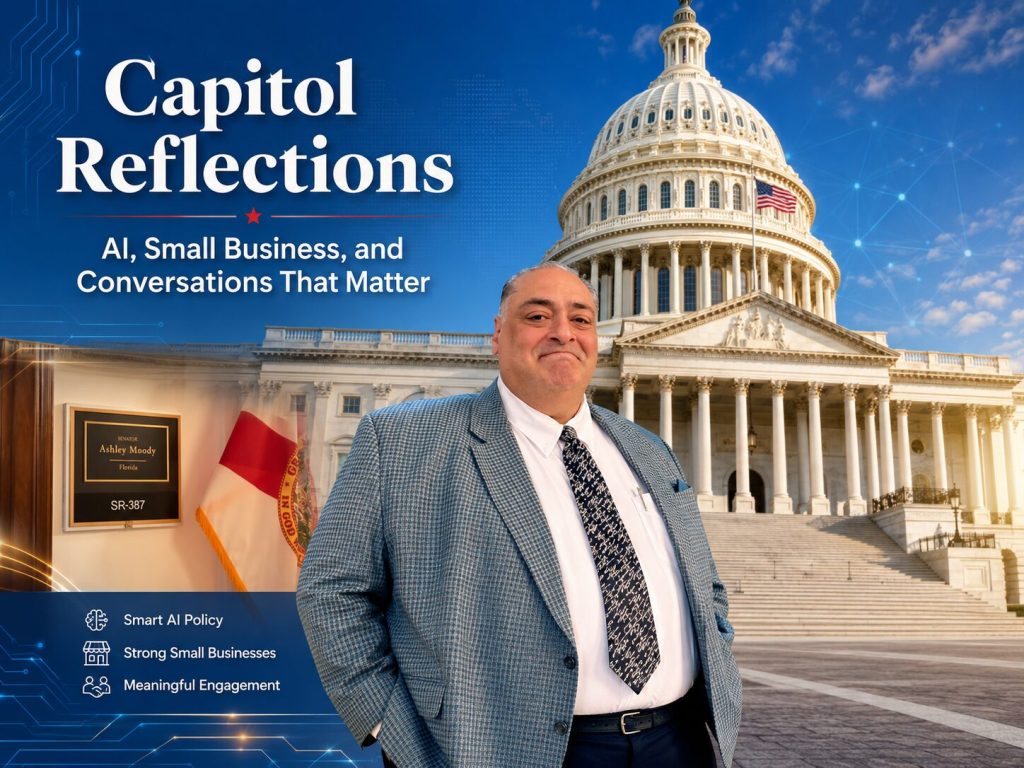
My visit to the Capitol last week was, let’s just say, interesting.
There were moments of encouragement, moments of frustration, moments that made me proud to represent small technology businesses, and a few moments that reminded me why it is so important for people who actually build technology to show up in the rooms where technology policy is being discussed.
Before I say anything else, I want to acknowledge the amazing team at ACT | The Association for Competitive Technology. From leadership to administration to member liaisons, the ACT team continues to impress me with its professionalism, organization, and mission-driven focus. ACT represents small and medium-sized technology companies, entrepreneurs, innovators, and independent developers, advocating for policies that help innovation thrive.
This was my second major involvement with ACT in just the last few months. Earlier, I had the privilege of representing the small business technology voice in Belgium at the European Parliament. This time, the mission brought me to Washington, D.C., to meet with lawmakers and staff on both sides of the aisle.
The goal was simple but incredibly important:
Help lawmakers understand AI through the lens of small business.
Not through the lens of trillion-dollar companies.
Not through abstract headlines.
Not through fear-driven talking points.
But through the real-world experience of builders, entrepreneurs, consultants, developers, trainers, and small technology companies that are already using AI, building with AI, teaching AI, and helping customers adopt AI responsibly.
That perspective matters.
Because when Congress makes decisions about artificial intelligence, data privacy, child safety, competition, security, funding, and innovation, those decisions do not only affect Big Tech. They affect the small companies trying to compete, hire, serve customers, innovate, and survive.
A Rough Start at the Speaker’s Office
My first meeting of the morning was scheduled at the office of Speaker of the House Mike Johnson. Speaker Johnson currently represents Louisiana’s 4th Congressional District and serves as Speaker of the U.S. House of Representatives.
I was genuinely looking forward to the discussion.
Unfortunately, after waiting about 30 minutes, the meeting was cancelled.
At first, we were told the meeting had been mistakenly scheduled for the wrong day. A few hours later, we were told a staff member had contracted COVID-19, which caused the cancellation.
Not exactly the start I was hoping for.
Still, Washington is Washington. Schedules change. Things happen. I stayed optimistic because there were several more meetings ahead, and the day still had plenty of opportunity.
A Disappointing Meeting with My Congressman’s Office
My second meeting was with the office of Congressman Maxwell Frost, who represents Florida’s 10th Congressional District, which includes Orlando and Central Florida.
As someone from the Orlando area, I was especially interested in this meeting. I wanted to discuss how AI is impacting small businesses, training organizations, technology entrepreneurs, and local companies in Central Florida.
Unfortunately, this was the most disappointing meeting of the day.
The Congressman was not present, which is understandable. Members of Congress are busy, and staff meetings are a normal part of advocacy work. The bigger issue was the tone and energy of the meeting itself. The staff representative did not appear engaged, curious, or interested in the conversation.
That was discouraging.
When small business owners and technology leaders travel to Washington to share real-world insight, we are not there to waste anyone’s time. We are there because the laws being discussed today will affect how companies hire, build, secure data, protect children, compete, and innovate tomorrow.
I also found the office environment personally disappointing. In my view, congressional offices should reflect the dignity of public service, regardless of party or political disagreement. Strong political opinions are part of democracy. Passion is expected. But professionalism still matters, especially in spaces that represent the American people.
That meeting reminded me of something important:
AI policy cannot be built only by people who think they already know everything about AI.
The technology is moving too fast. The impact is too broad. The stakes are too high.
The Best Meeting of the Day: Senator Ashley Moody’s Office
The highlight of the day came during our meeting with the office of Senator Ashley Moody of Florida. We met with Austin Smykal, Deputy Chief Counsel, and the difference in tone was immediate.
This was the kind of meeting you hope for when you go to Washington.
There was compassion.
There was understanding.
There was a sincere willingness to listen.
Most importantly, there were smart questions.
We discussed the importance of small businesses in the new AI era. This is an issue I care deeply about because small businesses are not just consumers of technology. Many of them are builders, implementers, consultants, educators, and innovators. They are the companies helping America actually adopt these technologies.
We also discussed child safety, including recent proposals around security and permissions for children under 13 and the role parents should play in digital consent and access. This is one of those areas where thoughtful policy is absolutely necessary. We need to protect children without creating rules that are impossible for small companies to implement or that unintentionally punish responsible innovators.
Another major topic was quantum computing.
I strongly believe the United States must continue investing aggressively in quantum research. AI is already transforming the world, but quantum computing has the potential to create another massive wave of disruption in cybersecurity, medicine, logistics, finance, simulation, and scientific discovery.
This is not science fiction anymore.
It is a strategic race.
If America wants to lead the next generation of computing, we need serious public and private investment in quantum technologies. That means research funding, workforce development, university partnerships, startup support, and a national sense of urgency.
This meeting gave me hope because it felt like a real conversation. Not a photo opportunity. Not a checkbox. A conversation.
And that matters.
A Productive Conversation with Congressman Lou Correa’s Office
My final meeting was with the office of Congressman Lou Correa, who represents California’s 46th Congressional District. Congressman Correa has been in Congress since 2017.
We met with Alicia Seagraves, who works on policy issues for Congressman Correa’s office.
This was a very pleasant and productive meeting.
We discussed several issues related to small businesses and AI, including innovation, regulation, competition, and the practical challenges that smaller companies face when policy is written with only large enterprises in mind.
One thing I appreciated was the clear California-first perspective from Congressman Correa’s office. The guiding question was essentially:
“Is it good for California?”
I actually respect that.
Every elected official should be thinking deeply about the people, businesses, workers, and communities they represent. For California, AI policy has massive implications because the state is home to so much technology innovation, venture capital, research, and entrepreneurship.
Congressman Correa has also been a strong friend to ACT over the years, and it was clear that his office understands the value of hearing from small business voices, not just the biggest names in the industry.
The Bigger Lesson: Small Businesses Must Stay in the AI Policy Conversation
By the end of the day, my experience was a mixed bag.
Some meetings were excellent. Some were disappointing. Some gave me hope. Some reminded me how disconnected parts of government can be from the people actually building and deploying technology.
But overall, I walked away even more convinced of this:
Small businesses need a louder voice in AI policy.
AI laws and regulations are coming. Some will be helpful. Some may be necessary. Some may be dangerous if written poorly.
The danger is not regulation itself.
The danger is regulation written without understanding how small companies operate.
A large enterprise can hire compliance teams, legal teams, policy teams, security teams, and lobbyists. A small business cannot always do that. When laws are too complex, too vague, too expensive, or too burdensome, the result is often simple:
Big companies get stronger.
Small companies get squeezed.
That is why organizations like ACT matter. That is why these meetings matter. That is why showing up matters.
If we want responsible AI, we need lawmakers to understand more than the risks. They must also understand the opportunity.
AI can help small businesses automate repetitive tasks, improve customer service, analyze data, build better products, compete globally, train employees, reduce costs, and serve customers in ways that were impossible just a few years ago.
But bad policy can slow that down.
Good policy can accelerate it.
My Message to Lawmakers
If I could summarize my message to lawmakers in a few points, it would be this:
First, listen to small businesses before writing AI laws. The companies building practical AI solutions every day have insight that cannot be replaced by academic theory or headlines.
Second, do not regulate small companies as if they are trillion-dollar platforms. The compliance burden must be realistic.
Third, protect children and consumers thoughtfully. Safety matters, but implementation details matter too.
Fourth, support American leadership in AI and quantum computing. These are not optional technologies. They are central to economic competitiveness and national security.
Fifth, stay humble. Nobody knows everything about AI. Not business leaders. Not technologists. Not lawmakers. Not staffers. This technology is evolving too quickly for arrogance.
The best meetings I had were the ones where people listened, asked questions, and treated the conversation seriously.
That is how good policy starts.
Thank You, ACT
Once again, I want to thank the ACT team.
You folks are unbelievable.
I truly enjoyed my time with you, and I am grateful to be a member of an organization that gives small technology companies a seat at the table.
I am already looking forward to next year in Belgium, where I hope to once again contribute my expertise on technology policy, AI, innovation, and, of course, my highly advanced research into Belgian fries and waffles.
Because public policy is important.
AI is important.
Small business is important.
But let’s be honest: waffles help too.


1 thought on “My Visit to the Capitol”
Thank you, both for going and for this summary. I learned (or modified my perspective) on a number of issues you raised. It would be easy to dismiss Congress as clueless, but it was encouraging that you met some policy advisors who had the good sense (and common decency) to listen attentively.
It is clear that the technology is moving faster than Congress can keep up with, and organizations like ACT will be critical in helping them form reasonable and dynamic policy.
Comments are closed.