
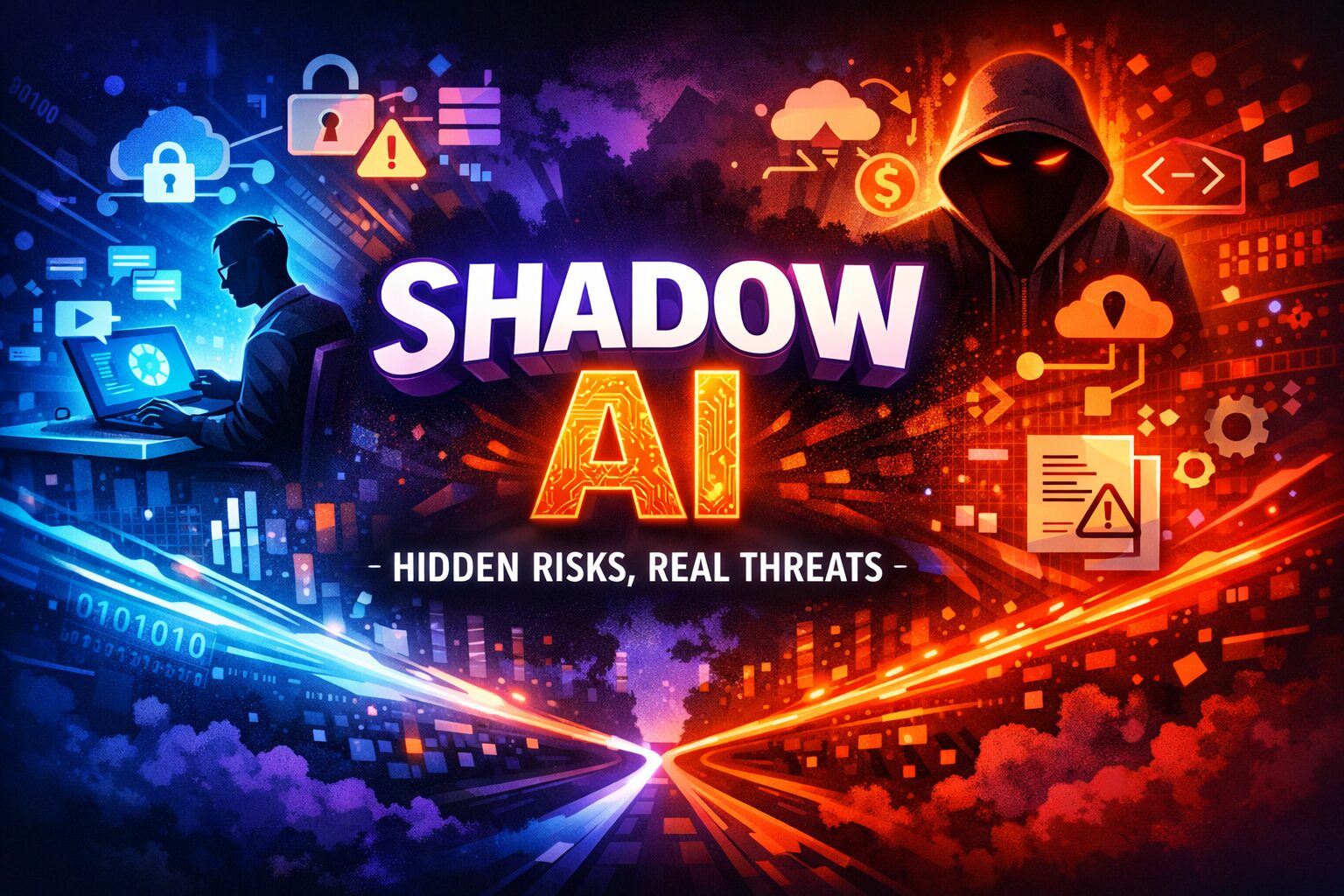
Let’s be honest: Shadow IT never went away. It just got smarter.
Today, it has a new name: Shadow AI.
Employees are quietly using ChatGPT, Copilot alternatives, browser extensions, transcription bots, AI design tools, and code assistants to get their work done faster. And from their point of view? They’re being innovative. They’re being productive. They’re being resourceful.
From the organization’s point of view?
They’re uploading internal data into tools you didn’t approve, didn’t secure, and can’t audit.
That’s Shadow AI. And it’s already inside your organization.
Shadow AI Isn’t a People Problem, It’s a Leadership Problem
Most Shadow AI doesn’t come from bad actors. It comes from good employees solving real problems:
“This AI summarizes meetings better than our official tool.”
“This one writes SQL in seconds.”
“This chatbot explains our product docs faster than our wiki.”
“This image tool makes my presentations not look terrible.”
The intent is productivity.
The outcome can be data leakage, compliance violations, and risk you can’t even see.
Shadow AI is what happens when:
The business moves faster than IT
Security policies are written for yesterday’s tools
Leaders say “no” to AI long enough that employees say “fine, I’ll do it myself”
If people feel blocked, they’ll route around you. They always have. AI just makes that easier.
The Real Risk Isn’t AI, It’s Invisible AI
AI itself isn’t the threat. Unobservable AI usage is.
Here’s where Shadow AI quietly hurts organizations:
1. Data Leakage Happens in Plain Sight
Employees paste:
Customer data
Support transcripts
Financial numbers
Source code
Architecture diagrams
Into tools you don’t control, with data retention policies you didn’t approve.
You may already be violating:
GDPR
HIPAA
SOC 2
PCI
Internal data handling policies
…and not even know it.
2. Compliance & Legal Risk Grows Quietly
When regulators ask:
“Where does your data go when employees use AI tools?”
If your answer is:
“We don’t know.”
That’s not a technical gap. That’s a governance failure.
3. Your AI Strategy Gets Undermined
Organizations invest in:
Microsoft Copilot
Azure OpenAI
Enterprise LLM platforms
Private AI endpoints
Meanwhile, employees use:
Free tools
Consumer accounts
Browser plugins
Random SaaS AI startups
Now you have:
Fragmented workflows
Inconsistent outputs
No learning loop
No control plane
No visibility into value or risk
You’re paying for AI… while Shadow AI delivers the actual productivity.
That’s a strategic disconnect.
You Can’t Govern What You Pretend Isn’t Happening
The worst Shadow AI strategy is pretending Shadow AI doesn’t exist.
Banning AI outright doesn’t work.
Employees won’t stop using it. They’ll just stop telling you.
The organizations winning with AI right now are doing something different:
They assume Shadow AI already exists, and they design governance around reality, not policy documents.
What Smart Organizations Do Instead
Here’s the shift:
❌ “AI is dangerous. Lock it down.”
✅ “AI is inevitable. Make the safe path the easy path.”
1. Make Approved AI Tools Actually Useful
If your official tools:
Are slow
Have limited access
Are buried in portals
Require ticket requests
People will use Shadow AI.
Make the approved option:
Faster
Easier
More capable
Embedded in daily workflows (Office, Teams, IDEs, browsers)
Convenience is security.
2. Create Clear AI Usage Guardrails (Not Legalese)
Your AI policy should fit on one page:
✔️ What data can be used with AI
❌ What data cannot
✔️ Which tools are approved
❌ Which classes of tools are prohibited
✔️ What happens if mistakes occur
✔️ Who to ask when unsure
If your policy needs a lawyer to interpret it, no one will follow it.
3. Build an AI Control Plane
You need:
Identity-based access to AI tools
Logging and auditability
Data boundary controls
Approved prompt and workflow templates
Visibility into usage patterns
This is where enterprise AI platforms, Foundry, Fabric, Azure OpenAI, and secure agent frameworks actually matter.
Not because they’re cool. Because they give you control without killing innovation.
4. Train People on “AI Hygiene”
Most employees don’t know:
What data is sensitive
How prompts are stored
Whether AI tools train on their inputs
What “enterprise-safe” actually means
Teach them:
What not to paste into AI
How to anonymize data
How to use approved tools
Why governance protects them too
This isn’t about fear. It’s about professional literacy in the AI age.
The Hard Truth
Shadow AI is a symptom, not the disease.
The disease is:
Slow enablement
Unclear policy
Lack of modern AI platforms
Leadership hesitation
Treating AI as an IT experiment instead of a business capability
If your organization doesn’t provide:
Fast, safe, sanctioned AI, Employees will build their own AI supply chain. And you won’t like where your data ends up.
Final Thought
Shadow AI isn’t coming.
It’s already here.
It’s already being used.
It’s already reshaping how work gets done.
You have two choices:
- Ignore it and accept invisible risk.
- Design for it and turn it into a competitive advantage.
The organizations that win in the AI era won’t be the ones that banned AI first. They’ll be the ones that governed it best.
Contact us at The Training Boss to discuss your AI Posture and how to embrace Shadow AI for your organization by adding governance, security, and education for all.
