The Cybersecurity Game Is Changing, And Microsoft Just Raised the Stakes!
At Microsoft Ignite 2026 in San Francisco, Microsoft introduced one of its most significant advancements in enterprise cybersecurity: Microsoft Perception, a new agentic security platform designed to fundamentally transform how organizations defend themselves against cyberattacks.
Previously introduced as Project Perception in July 2026, the platform officially reached General Availability (GA) at Ignite on November 17, 2026.
But this is much more than another cybersecurity product.
Microsoft Perception represents a shift in how we think about enterprise security: moving from individual tools and disconnected alerts toward coordinated teams of autonomous AI agents working continuously to identify threats, investigate attacks, and strengthen defenses.
The idea is compelling:
What if your cybersecurity tools could think like attackers, investigate like experienced security analysts, and coordinate remediation before vulnerabilities become disasters?
That is exactly the vision behind Microsoft Perception.
Let’s explore how it works, why it matters, and what organizations should consider before implementing it.
What Exactly Is Microsoft Perception?
Microsoft Perception is an enterprise-grade, multi-agent cybersecurity system that brings together specialized AI agents to collaborate across the complete security lifecycle.
Rather than relying entirely on human analysts to interpret thousands of alerts, correlate activity across systems, and coordinate remediation, Perception uses intelligent agents to automate and orchestrate substantial portions of that work.
These agents operate through coordinated workflows called playbooks, sharing information and intelligence to achieve specific security outcomes.
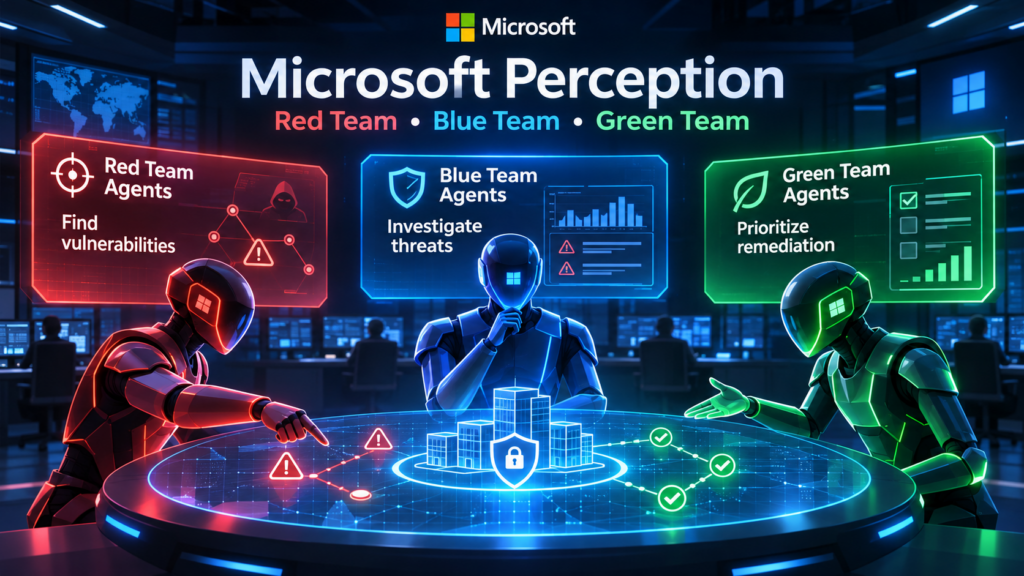
Microsoft organizes Perception around three specialized agent teams:
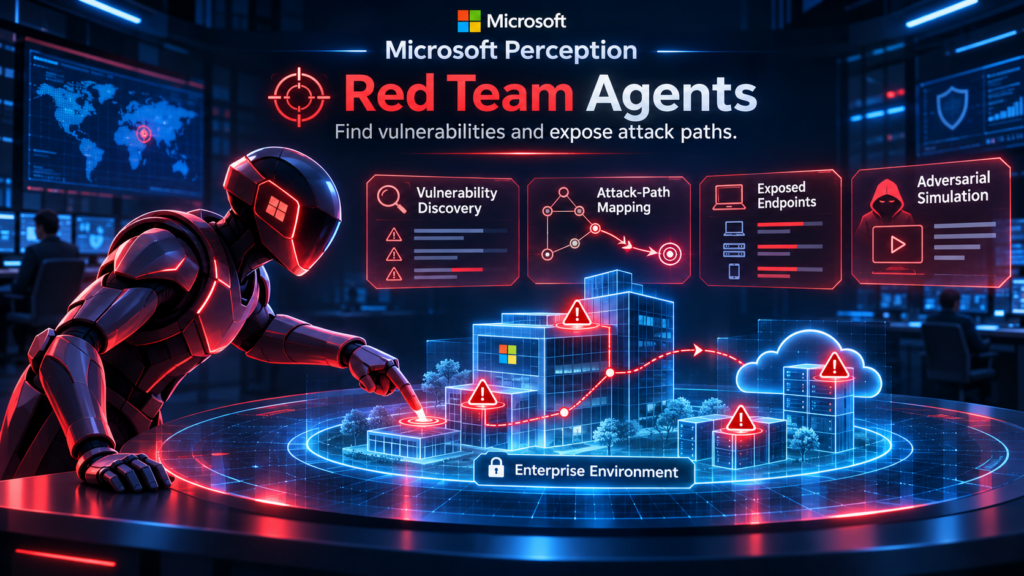
Red Team Agents: Discover weaknesses and simulate potential attacks.
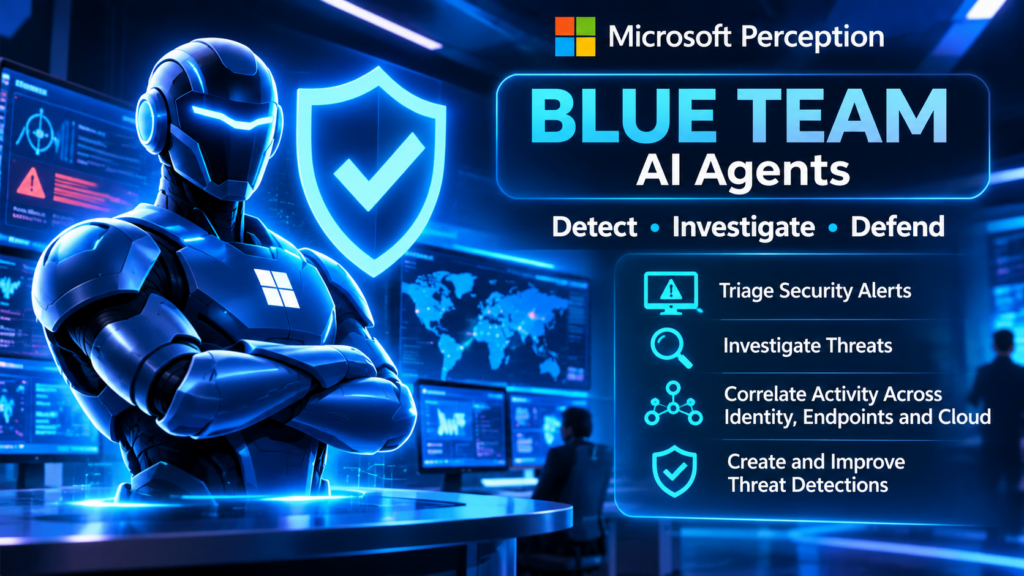
Blue Team Agents: Detect suspicious activity, investigate threats, and strengthen detection capabilities.
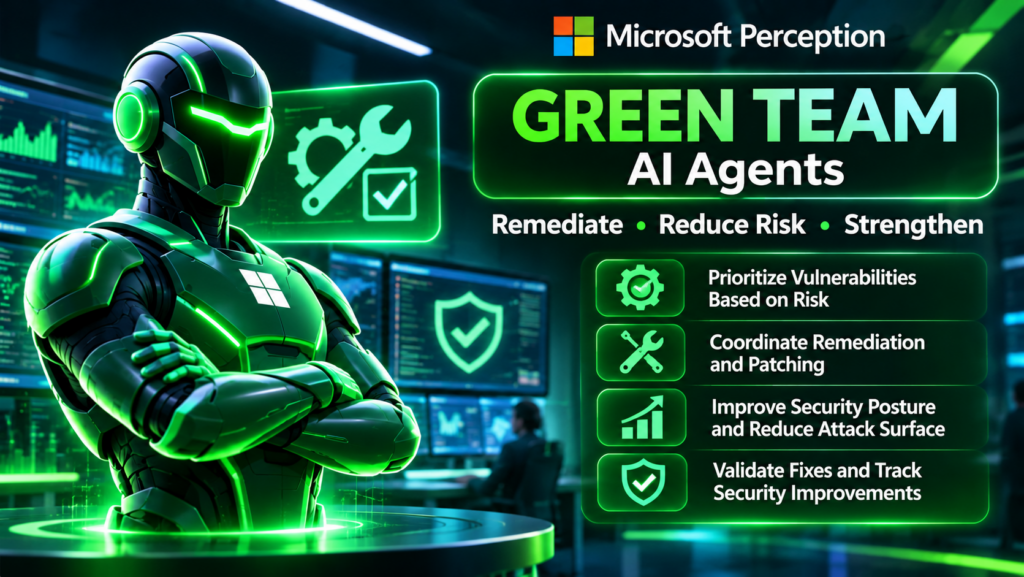
Green Team Agents: Prioritize risks, coordinate remediation, and improve security posture.
Think of Microsoft Perception as a digital cybersecurity team that never gets tired, never stops analyzing security signals, and can coordinate complex security activities at a scale that would be difficult to achieve manually.
Importantly, Perception is not designed to eliminate human security professionals.
Instead, it helps them become dramatically more effective by automating repetitive work, surfacing actionable intelligence, and keeping people in control of high-impact security decisions.
Meet the Three Teams Behind Microsoft Perception
Red Team Agents: Think Like the Attacker
In traditional cybersecurity, Red Teams are responsible for simulating attacks to discover potential weaknesses before malicious actors exploit them.
Microsoft Perception brings AI agents into this process.
Red Team Agents can help organizations:
Discover potentially exploitable vulnerabilities.
Analyze attack paths through applications and infrastructure.
Simulate adversarial behaviors within authorized security testing.
Evaluate weaknesses in application code and configurations.
Identify which vulnerabilities represent meaningful exploitation risks.
For example, imagine an enterprise application hosted in Microsoft Azure with several publicly accessible endpoints.
A Red Team Agent could analyze the application’s attack surface and help identify a vulnerable component that might allow unauthorized access.
Instead of simply producing a generic list of vulnerabilities, the objective is to provide evidence about which weaknesses could realistically be exploited.
This distinction matters.
Not every vulnerability represents the same level of business risk.
Understanding the actual exploitability of a vulnerability can help security teams focus their attention and resources where they matter most.
Microsoft is also extending these capabilities through its advanced code vulnerability research technology, including Codename MDASH.
Blue Team Agents: Detect, Investigate, and Defend
Blue Teams are responsible for protecting the organization by monitoring activity, investigating suspicious behavior, and responding to security incidents.
Microsoft Perception’s Blue Team Agents bring AI-powered reasoning and automation into these responsibilities.
They help organizations:
Triage large volumes of security alerts.
Correlate activity across identities, endpoints, email, and cloud environments.
Investigate suspected attacks.
Reconstruct attack timelines.
Identify compromised accounts and resources.
Recommend appropriate incident responses.
Create and improve threat detection rules.
One of the most interesting announcements at Ignite concerns Microsoft’s Triage Agent.
According to Microsoft, the agent can now triage approximately 80% of the alert volume in a typical Microsoft Defender security queue.
This claim is based on Microsoft’s analysis of approximately eight million security alerts across Defender workloads. Actual coverage varies by organization and is not guaranteed.
Consider what that could mean for an enterprise security operations center.
Instead of security analysts spending hours investigating routine or low-priority alerts, AI agents can perform initial analysis and provide supporting evidence.
Human analysts can then focus on incidents requiring greater attention, deeper investigation, and business judgment.
The objective isn’t simply faster alert processing.
It’s helping organizations make better security decisions, sooner.
Green Team Agents: Fix Problems and Strengthen Defenses
Finding a vulnerability is important.
Investigating a potential attack is essential.
But neither activity delivers its full value unless organizations actually address the underlying risks.
This is where Green Team Agents come into play.
Green Team Agents focus on risk reduction, remediation, and improving the organization’s security posture.
They can help:
Prioritize vulnerabilities based on exposure and business risk.
Recommend corrective actions.
Coordinate remediation activities.
Support patch management workflows.
Identify opportunities to harden infrastructure.
Reduce the organization’s attack surface.
Validate and track improvements.
For example, imagine that a Red Team Agent identifies an exploitable vulnerability in an application, and a Blue Team Agent determines that suspicious activity has already targeted the affected system.
A Green Team Agent can help prioritize remediation, coordinate the appropriate workflow, and guide the organization toward eliminating or mitigating the vulnerability.
Depending on the supported workflow and the organization’s policies, this could include coordinating patching through Microsoft Intune or identifying temporary protective measures when an immediate patch is not feasible.
The result is a more connected security lifecycle: find the risk, investigate the threat, and coordinate the fix.
The Real Innovation: All Three Teams Work Together!
Individually, these capabilities are impressive.
But the most exciting aspect of Microsoft Perception is how the agents collaborate.
Traditional cybersecurity platforms often operate across separate processes.
One tool identifies a vulnerability.
Another tool detects suspicious activity.
A security analyst investigates the incident.
An IT team receives a remediation ticket.
And potentially days later, someone implements the fix.
Microsoft Perception aims to connect these activities through intelligent multi-agent orchestration.
The platform uses playbooks that coordinate specialized agents around specific security objectives.
These playbooks can orchestrate security investigations, vulnerability analysis, detection engineering, and remediation workflows.
All while maintaining governance, permissions, and human approval where required.
A Practical Example: Detecting and Responding to a Compromised Identity
Imagine a company operating several business applications on Microsoft Azure.
An employee’s credentials are compromised through a phishing attack.
An attacker successfully authenticates and begins exploring cloud resources.
Here is an illustrative workflow showing how a coordinated agentic defense could help.
Step 1, Blue Team: Detect Suspicious Activity
A Blue Team Agent investigates unusual authentication events and correlates them with security signals from Microsoft Entra ID, endpoints, and cloud infrastructure.
It identifies suspicious behavior and begins reconstructing the attack timeline.
Step 2, Red Team: Identify Potential Attack Paths
Authorized Red Team analysis evaluates exposed systems, configurations, and potential weaknesses that could allow the attacker to escalate privileges or access additional resources.
Step 3, Green Team: Prioritize Remediation
A Green Team Agent helps identify corrective actions, such as reducing excessive permissions, addressing vulnerable configurations, or coordinating additional security protections.
Step 4, Human Security Team: Review and Approve
Security professionals review the findings and authorize high-impact actions according to organizational policies.
Step 5, Continuous Improvement
The organization uses the findings to improve detection coverage, close security gaps, and strengthen its defenses against similar attacks.
This is an illustrative example rather than a promise that every step is automatically available in every environment.
However, it demonstrates the value of an agentic system that combines shared context, specialized capabilities, and coordinated action.
Microsoft Perception Is More Than Three Teams of Agents
Underneath the surface, Microsoft Perception combines several important architectural capabilities.
Multi-Agent Orchestration
Perception uses an orchestration harness to coordinate agents, distribute work, and manage execution across complex security workflows.
Specialized Cybersecurity AI Models
Microsoft Perception uses purpose-built AI models, including Microsoft’s MAI-Cyber family, alongside other models selected for different security tasks.
The objective is to balance reasoning quality, performance, and cost.
Security Context and Threat Intelligence
Agents can use signals from the Microsoft Security ecosystem, including identity, endpoint, cloud, and application security information.
Microsoft is also extending supported integrations to third-party environments, including AWS, Okta, and Salesforce.
This matters because most enterprise security environments extend beyond a single vendor.
Model Context Protocol (MCP) and API Integration
Microsoft Perception supports integration scenarios involving MCP and APIs, allowing organizations to invoke supported playbooks from existing operational tools.
This opens interesting opportunities for integrating agentic security with broader enterprise workflows.
Specific integrations and capabilities remain subject to product availability, permissions, and supported configurations.
Governance and Human Oversight
Autonomous cybersecurity cannot operate without adequate controls.
Microsoft Perception incorporates least-privilege access, policy guardrails, auditability, and human approval for critical actions.
These capabilities are essential because an incorrectly executed security response could interrupt legitimate business operations.
What About Microsoft Foundry and Microsoft Agent Framework?
For developers and architects already working with Microsoft Foundry and Microsoft Agent Framework, Perception introduces an interesting new dimension to the Microsoft AI ecosystem.
Let’s distinguish their responsibilities.
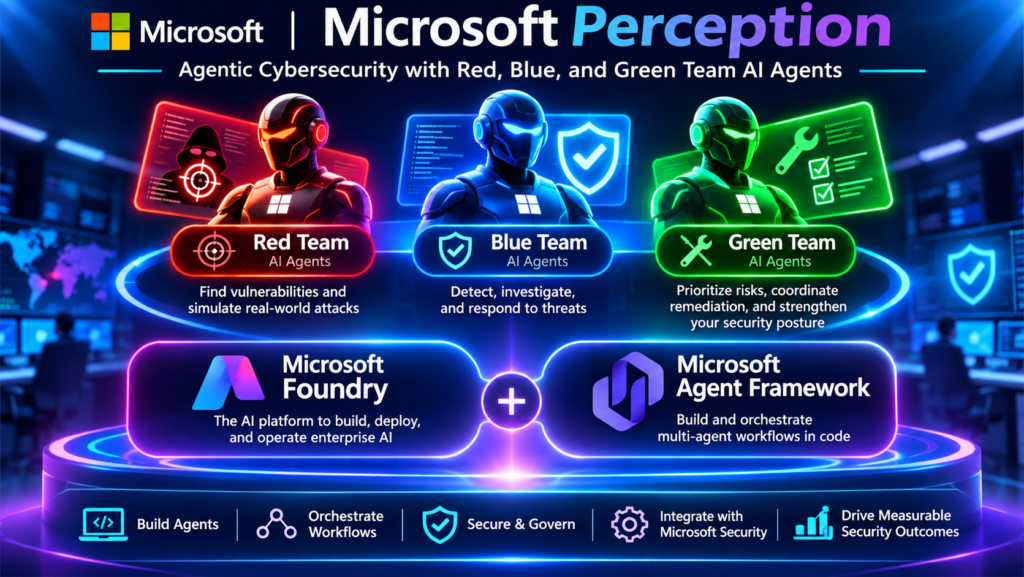
Microsoft Foundry provides the services and capabilities organizations use to build, deploy, evaluate, and operate enterprise AI applications and agents.
Microsoft Agent Framework provides developers with the programming capabilities to build intelligent agents and orchestrate multi-agent workflows.
Microsoft Perception is a specialized cybersecurity system that applies multi-agent orchestration to enterprise security operations.
These technologies are complementary rather than interchangeable.
Developers can use Microsoft Agent Framework to create business-specific intelligent agents, while security teams use Microsoft Perception to help protect the infrastructure, identities, applications, and resources those agents depend on.
Perception’s MCP and API integration capabilities also create opportunities for coordinating supported security workflows with custom enterprise applications, including scenarios involving Microsoft Foundry.
However, Perception is not simply a collection of Microsoft Agent Framework agents that developers deploy themselves. It is a managed security product with its own architecture, governance, orchestration, and licensing.
For organizations investing heavily in agentic AI, this distinction is important.
Building intelligent agents is only one part of the challenge. Securing the environment in which those agents operate is equally critical.
Why Microsoft Perception Matters to Businesses
Microsoft Perception isn’t relevant only to large enterprises with sophisticated cybersecurity teams.
The underlying challenges it addresses affect organizations across industries.
1. Cyberattacks Are Becoming Faster
Attackers are increasingly using automation and AI to discover vulnerabilities, launch phishing campaigns, and exploit weaknesses.
Security teams need tools capable of keeping pace.
2. Security Teams Are Overwhelmed
Organizations generate enormous volumes of security telemetry and alerts.
AI-powered triage and investigation can help analysts spend less time processing noise and more time investigating meaningful threats.
3. Vulnerability Management Is Often Disconnected
Finding vulnerabilities is relatively straightforward compared with prioritizing, fixing, and validating them.
Perception brings greater coordination to that process.
4. Enterprise Environments Are Becoming More Complex
Azure, Microsoft 365, external cloud providers, SaaS platforms, and autonomous AI agents create increasingly complex security environments.
Coordinated security intelligence can help organizations understand risks spanning multiple systems.
5. Businesses Need Security Outcomes, Not More Dashboards
A dashboard showing hundreds of vulnerabilities isn’t the same as actually reducing business risk.
Microsoft Perception emphasizes moving from detection toward investigation, remediation, and measurable security improvements.
This may be the most important shift of all.
Getting Started with Microsoft Perception
With Microsoft Perception now generally available, organizations can begin evaluating how it fits into their cybersecurity strategy.
Microsoft offers consumption-based pricing options, including pay-as-you-go and the AI Flex Plan. The platform also includes usage and cost management capabilities.
However, successful adoption requires more than enabling a product.
Organizations should approach implementation systematically.
First, assess the existing security environment. Understand current tools, Microsoft Defender coverage, identity controls, cloud resources, and vulnerability management processes.
Second, identify high-value use cases. Start with manageable scenarios such as security alert triage, authorized vulnerability assessment, or exposure prioritization.
Third, establish governance and permissions. Define what agents can access, which actions can be automated, and which operations require human approval.
Fourth, configure and evaluate playbooks. Select the appropriate Red, Blue, and Green Team workflows, connect supported security data, and validate their behavior against realistic scenarios.
Finally, measure outcomes and expand. Monitor detection quality, investigation efficiency, remediation progress, usage costs, and operational impact before increasing automation.
A measured rollout is essential to ensuring AI-powered security delivers value without introducing unnecessary operational risk.
How The Training Boss Can Help Your Organization Implement Microsoft Perception
At The Training Boss, we believe the next generation of enterprise technology will be powered by intelligent AI agents working alongside experienced professionals.
Microsoft Perception is a compelling example of that future.
But adopting an advanced multi-agent cybersecurity platform requires the right architecture, implementation strategy, governance, and training.
That is where The Training Boss can help.
Our consulting, architecture, and technical training services can help organizations evaluate, plan, configure, and adopt Microsoft Perception as part of their broader Microsoft security and Azure environments.
Red Team Implementation and Enablement
We can help your organization plan and configure authorized Red Team workflows to identify vulnerabilities, evaluate attack surfaces, and improve understanding of potential exploitation risks.
This includes selecting appropriate use cases, establishing testing boundaries, and defining meaningful security assessment outcomes.
Blue Team Implementation and Enablement
We can help your security and IT teams configure supported Blue Team capabilities for alert triage, incident investigation, detection improvement, and coordinated security operations.
Our objective is to help your teams understand how to apply AI-powered security investigations effectively while maintaining appropriate operational oversight.
Green Team Implementation and Enablement
We can help your organization establish risk prioritization and remediation workflows, connect supported Microsoft security tools, and develop processes for coordinating corrective actions.
The goal is to move beyond vulnerability reporting toward measurable improvements in security posture.
Architecture, Integration, and Training
In addition to agent configuration, The Training Boss can assist with:
Microsoft Perception readiness and architecture assessments.
Security data integration and workflow planning.
Microsoft Azure and Microsoft security ecosystem alignment.
Multi-agent playbook selection and configuration.
Governance, permissions, and human approval processes.
Supported MCP and API integration planning.
Proof-of-concept implementations and validation.
Technical workshops and knowledge transfer for security and IT teams.
Whether your organization is just beginning to explore agentic cybersecurity or already has an established security operations center, we can help you evaluate the technology and develop a practical adoption roadmap.
Ready to Bring Agentic Cybersecurity to Your Organization?
Cybersecurity is entering a new era.
The question is no longer simply whether your organization has the right security tools.
The question is whether those tools can work together intelligently, continuously, and fast enough to keep pace with modern threats.
Microsoft Perception offers an exciting direction for achieving that goal.
Let The Training Boss help you explore and implement Microsoft Perception with Red Team, Blue Team, and Green Team capabilities tailored to your organization’s needs.
Visit The Training Boss to discuss your requirements, explore our consulting and training services, and begin planning your organization’s next generation of AI-powered cybersecurity.
Protect smarter. Respond faster. Build a stronger security posture with intelligent AI agents.
Additional Resources
For additional technical information and the latest product availability details, explore Microsoft’s official resources:
The Training Boss is an independent technology consulting and training organization. Microsoft Perception capabilities, licensing, pricing, and availability are subject to Microsoft’s current product terms and supported configurations.