
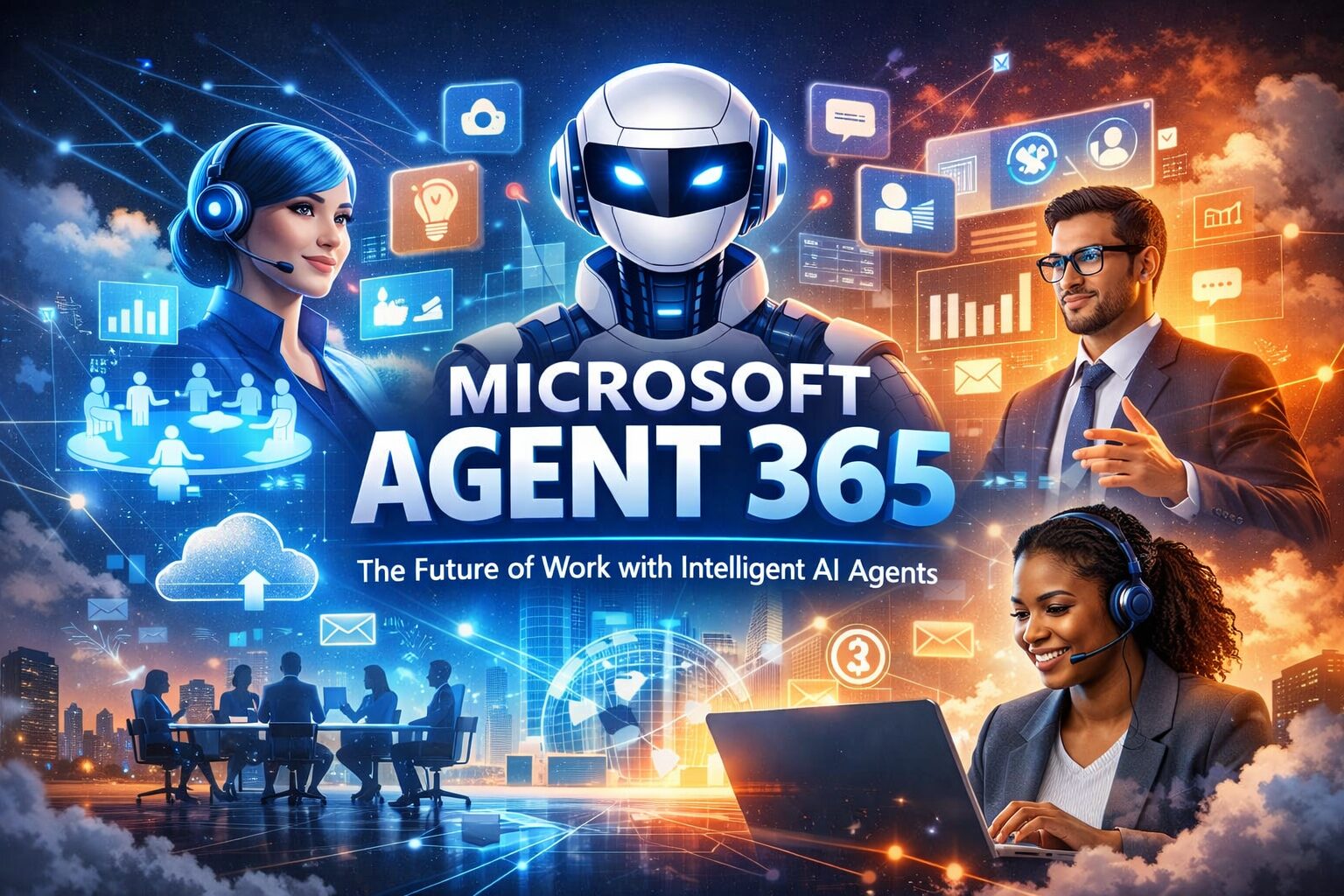
The way we interact with technology is undergoing a major shift. For years, software has been something we used. We opened applications, clicked buttons, wrote queries, and manually orchestrated workflows.
Today, a new model is emerging: software that works for us.
This is where Microsoft Agent 365 comes into play.
Agent 365 represents Microsoft’s move toward AI-powered autonomous assistants embedded throughout the Microsoft 365 ecosystem. Instead of simply responding to prompts like traditional AI chatbots, these agents are designed to plan, reason, take action, and collaborate with humans and systems across enterprise workflows.
In other words, AI is evolving from a tool into a teammate.
Let’s explore why Microsoft created Agent 365, what its goals are, and how it is transforming modern work.
Why Microsoft Agent 365 Exists
Organizations today face several challenges:
Exploding amounts of data
Increasing operational complexity
Rising expectations for speed and automation
Shortage of specialized technical talent
Employees overwhelmed by repetitive tasks
Traditional automation solutions (RPA, scripts, workflows) require heavy configuration and rigid logic. They struggle when conditions change or when tasks require reasoning.
Agent 365 exists to solve this gap.
Its mission is simple:
Create intelligent agents that can understand goals, reason through tasks, interact with enterprise systems, and execute work autonomously.
Instead of telling software exactly how to do something, users can now describe what they want to achieve.
The agent determines how to get there.
The Vision Behind Agent 365
Microsoft’s long-term vision is a multi-agent enterprise, where specialized AI agents collaborate with humans and with each other.
Think of them as:
Digital analysts
Process coordinators
Research assistants
Customer service specialists
Operations managers
Each agent can be tailored for specific business roles while operating within the Microsoft 365 environment, enterprise data, and governance framework.
The key goals behind the technology include:
1. Automating Knowledge Work
Most automation historically targeted manual or operational tasks. Agent 365 focuses on knowledge work—research, analysis, decision support, and coordination.
2. Connecting AI to Enterprise Context
Agents are grounded in organizational data from systems like documents, databases, and enterprise applications. This allows them to deliver context-aware intelligence.
3. Reducing Human Cognitive Load
Instead of employees spending hours searching for information, summarizing data, or coordinating tasks, agents handle the heavy lifting.
4. Enabling Natural Interaction
Users interact with agents through natural language conversations, removing the need for complex queries or programming.
5. Creating an Extensible AI Ecosystem
Organizations can create custom agents tailored to specific workflows, industries, or departments.
What Makes Agent 365 Different From Traditional AI Assistants
Not all AI assistants are agents.
Traditional AI assistants:
Answer questions
Generate text
Respond to prompts
Agent 365 goes much further.
Agents can:
✔ Plan multi-step tasks
✔ Call APIs and enterprise services
✔ Retrieve and analyze organizational data
✔ Execute workflows across applications
✔ Collaborate with other agents
✔ Continuously improve through feedback
Instead of answering a single question, an agent might complete an entire project task from start to finish.
Real-World Examples of Agent 365 in Action
To truly understand the power of Agent 365, let’s explore practical scenarios where these agents make a meaningful difference.
Example 1: The Intelligent Meeting Agent
Meetings are a massive productivity drain in most organizations.
An Agent 365 meeting assistant can:
• Prepare briefing summaries before meetings
• Pull relevant documents and data automatically
• Record and summarize meeting discussions
• Identify action items and assign tasks
• Track follow-ups and reminders
Instead of employees spending time writing notes and sending follow-ups, the agent handles the entire meeting lifecycle.
Result:
Faster decisions
Better accountability
Less administrative overhead
Example 2: The Sales Intelligence Agent
Sales teams constantly need insights from CRM systems, market reports, and customer communications.
A Sales Agent could:
Analyze customer history and purchasing behavior
Generate personalized outreach strategies
Draft proposal documents
Forecast deal probability
Identify cross-sell opportunities
Rather than manually compiling data from multiple systems, the agent delivers actionable intelligence instantly.
Example 3: The IT Operations Agent
IT teams are often overwhelmed by alerts, tickets, and system diagnostics.
An IT operations agent can:
Monitor infrastructure events
Analyze system logs
Suggest root-cause diagnostics
Automate remediation steps
Create incident reports
Instead of reacting manually to alerts, IT teams get AI-driven operational assistance that speeds up resolution.
Example 4: The Research and Analysis Agent
Knowledge workers spend enormous amounts of time gathering and synthesizing information.
A research agent can:
Search internal and external sources
Summarize complex documents
Identify trends in datasets
Generate reports or executive summaries
What once took hours of research can now be delivered in minutes.
Example 5: The HR Talent Agent
Human resources teams manage recruiting pipelines, employee engagement, and policy compliance.
An HR agent might:
Screen resumes against job requirements
Draft interview summaries
Recommend candidate rankings
Generate onboarding plans
Answer employee policy questions
The result is faster hiring processes and better employee support.
The Power of Multi-Agent Collaboration
One of the most exciting aspects of Agent 365 is agent-to-agent collaboration.
Imagine a scenario where:
A Sales Agent identifies a new opportunity
A Finance Agent calculates pricing and margin
A Legal Agent reviews contract terms
A Project Agent prepares a delivery timeline
Instead of humans coordinating each step manually, the agents collaborate autonomously while keeping humans in the loop.
This transforms organizations into AI-augmented systems where work flows continuously.
Governance and Trust
Enterprise adoption of AI requires strong governance and security controls.
Agent 365 is designed to operate within enterprise guardrails, including:
Identity-based access control
Data compliance policies
Organizational security boundaries
Auditability and monitoring
This ensures agents operate responsibly while protecting sensitive corporate data.
Why Agent 365 Matters Right Now
The modern workplace is experiencing a perfect storm:
Increasing complexity
Rising productivity demands
Rapid digital transformation
Explosion of enterprise data
Human capacity alone cannot keep up.
Agent 365 represents the next evolution of work:
AI systems that actively participate in accomplishing business outcomes.
Rather than replacing people, these agents amplify human capability, allowing employees to focus on creativity, strategy, and decision-making.
The Future: Your AI Workforce
We are entering an era where organizations will not only hire people — they will also deploy agents.
Teams may soon look like this:
10 human employees
25 specialized AI agents
Each agent working continuously to support operations, research, analysis, and automation.
This isn’t science fiction.
It is the next phase of enterprise productivity.
Final Thoughts
Microsoft Agent 365 signals a major transformation in how software operates inside organizations.
Instead of applications that wait for instructions, we now have intelligent agents that pursue goals, coordinate tasks, and help organizations move faster than ever before.
The future of work will not just be human-driven or AI-driven.
It will be human–AI collaboration at scale.
And Agent 365 is one of the most important steps toward that future.
Does your organization need expertise in Agent 365 and Autonomous Agent in general? The Training Boss isready to partner with you to elevate your productivity and ROI. Reach out to us today.
