
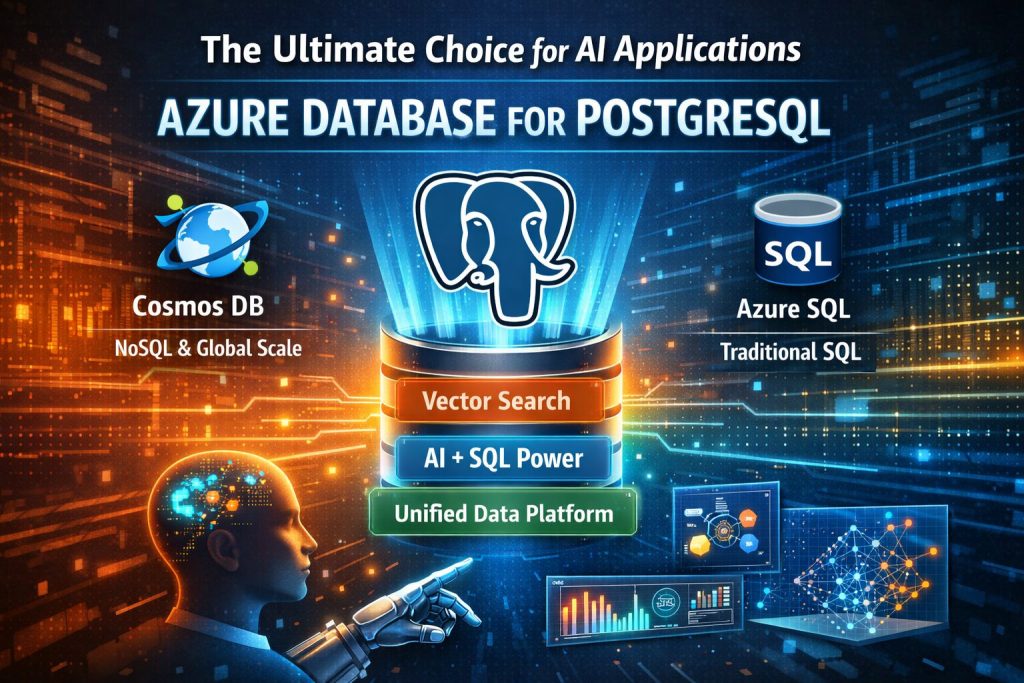
As enterprises rapidly build AI-powered applications, copilots, and intelligent agents, the database layer becomes a critical architectural decision. The database must handle embeddings, vector search, relational context, transactional integrity, and high-scale workloads, often simultaneously.
While services like Azure Cosmos DB and Azure SQL Database are excellent for many workloads, Azure Database for PostgreSQL has emerged as one of the most powerful and flexible foundations for modern AI applications.
In fact, the combination of PostgreSQL + vector search + relational intelligence makes it uniquely suited for AI architectures such as Retrieval Augmented Generation (RAG), AI agents, semantic search, and knowledge-based systems.
Let’s explore why PostgreSQL on Azure often outperforms Cosmos DB and Azure SQL for AI workloads.
1. Native Vector Search Built Directly Into PostgreSQL
Modern AI systems rely heavily on vector embeddings, high-dimensional representations of text, images, or documents used for semantic similarity search.
Azure Database for PostgreSQL supports this through:
pgvectorextensionNative vector data types
Approximate nearest neighbor search
Multiple vector indexing algorithms
These capabilities allow developers to store and query embeddings directly inside the database.
Typical AI query example:
SELECT *
FROM documents
ORDER BY embedding <-> '[vector]'
LIMIT 5;
PostgreSQL supports advanced vector index types such as:
IVFFlat
- HNSW
These indexes accelerate similarity search across millions of vectors.
Why this matters
AI applications require extremely fast semantic search to retrieve relevant context for LLM prompts. PostgreSQL enables:
Low-latency similarity search
Vector + relational filtering
Integrated embeddings storage
All without requiring a separate vector database.
2. Advanced Vector Performance with DiskANN
Azure has gone even further by integrating DiskANN, one of the fastest vector indexing algorithms available.
DiskANN can deliver:
Up to 10× faster vector search performance
Up to 4× cost savings for large embedding datasets.
This means PostgreSQL can support massive AI workloads at enterprise scale without sacrificing query performance.
3. AI Features Built Directly Into the Database
Azure Database for PostgreSQL includes AI-focused capabilities designed specifically for generative AI systems:
Azure AI extension
In-database embeddings generation
Semantic operators in SQL
Integration with AI models
These allow developers to execute AI reasoning and embedding generation inside the database itself, reducing latency and simplifying architecture.
For example:
Generate embeddings inside SQL
Perform semantic similarity queries
Combine AI reasoning with relational data
This transforms PostgreSQL into a true AI-native operational database.
4. Full SQL Power for RAG and AI Agents
One of PostgreSQL’s biggest advantages over document databases is relational query power.
AI systems often require complex filtering and contextual joins, such as:
Filtering embeddings by user permissions
Joining vector results with metadata
Combining vector similarity with business logic
PostgreSQL supports:
JOINs
window functions
aggregates
complex filters
This allows vector search and relational queries to run in the same engine.
Example:
SELECT d.title, d.contentFROM documents d JOIN customers c ON d.customer_id = c.id ORDER BY d.embedding <-> '[vector]' LIMIT 5;
5. Unified Data Model for AI Applications
AI systems often require multiple types of data simultaneously:
embeddings
structured relational data
JSON documents
metadata
geospatial data
PostgreSQL supports all of these natively:
JSONB for semi-structured data
full-text search
geospatial with PostGIS
relational tables
vector embeddings
This allows organizations to consolidate multiple systems into a single database platform.
6. Lower Architecture Complexity
With PostgreSQL, an AI stack can be dramatically simplified.
Instead of running:
relational database
vector database
metadata store
You can run all of them in PostgreSQL.
Benefits include:
fewer moving parts
lower latency
simpler architecture
reduced operational cost
Embeddings and metadata can live in the same tables, allowing consistent transactions and backups.
7. Open Ecosystem and Massive Developer Adoption
PostgreSQL is one of the most widely used open-source databases in the world.
This means:
enormous extension ecosystem
mature tooling
portability across clouds
strong developer community
Unlike proprietary platforms, PostgreSQL allows organizations to avoid vendor lock-in while still using enterprise-grade managed services.
Where Cosmos DB and Azure SQL Fit
To be clear, Cosmos DB and Azure SQL are still excellent services, they just serve different architectural goals.
Cosmos DB excels at:
globally distributed workloads
massive scale across regions
NoSQL data models
Azure SQL excels at:
traditional enterprise transactional systems
Microsoft ecosystem integrations
strong relational OLTP workloads
However, AI applications demand a hybrid model:
vector search
relational context
flexible schema
semantic querying
This is exactly where PostgreSQL shines.
The Future of AI Databases Is Hybrid
The next generation of applications will combine:
vector similarity
structured relational knowledge
AI reasoning
large-scale transactional workloads
Azure Database for PostgreSQL uniquely supports all of these capabilities in a single database platform.
With vector search, DiskANN indexing, semantic SQL, and deep AI integrations, PostgreSQL is quickly becoming one of the most powerful foundations for enterprise AI applications on Azure.
Bottom line:
If you are building RAG systems, copilots, semantic search, or AI agents, Azure Database for PostgreSQL offers the most complete and powerful database foundation in Azure today.

1 thought on “Why Azure Database for PostgreSQL Is the Strongest Choice for AI Applications”
Pingback: Dew Drop – April 7, 2026 (#4641) – Morning Dew by Alvin Ashcraft
Comments are closed.