
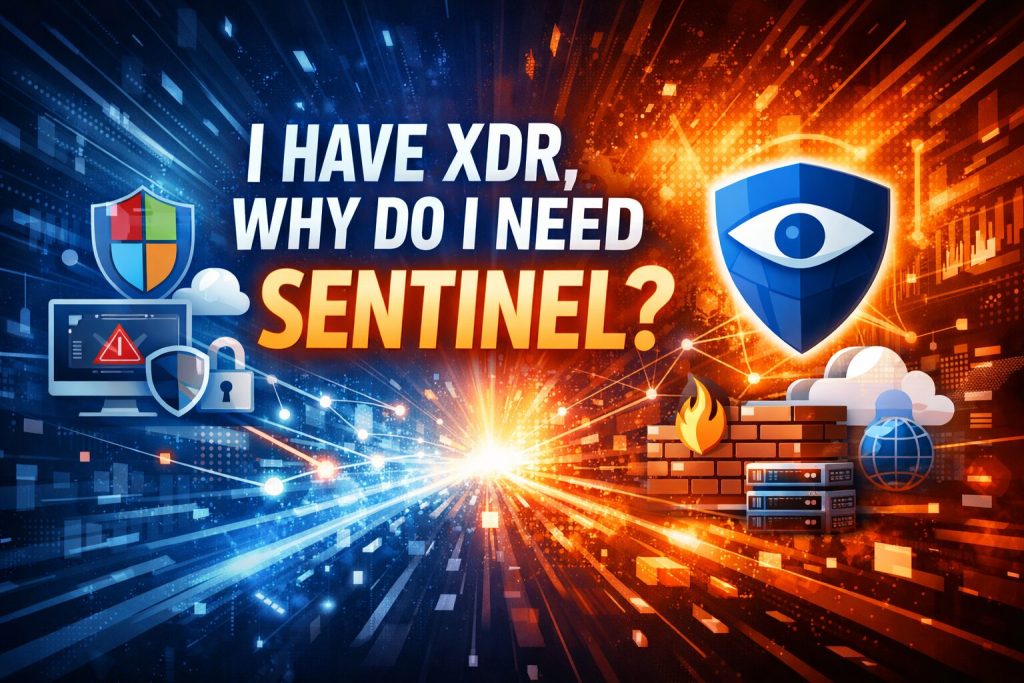
This is a question that comes up a lot with security leaders who see Microsoft XDR getting stronger every year.
Microsoft XDR is necessary but not sufficient for many organizations. Microsoft Sentinel exists to solve problems that XDR intentionally does not
Microsoft XDR: What it’s optimized for
Microsoft XDR (Defender XDR) is purpose-built for threat detection and response across Microsoft’s security stack:
Core strengths
-
Native signals from:
-
Defender for Endpoint
-
Defender for Identity
-
Defender for Office 365
-
Defender for Cloud Apps
-
-
High-fidelity detections
-
Automatic attack correlation (incidents)
-
Built-in response actions (isolate device, reset password, block user)
-
Low operational overhead
What XDR answers extremely well
“Is there an active attack happening right now across our Microsoft estate?”
XDR is excellent for:
-
Endpoint, identity, email, SaaS attacks
-
Reducing alert noise
-
Fast containment
Design assumption
-
Data mostly comes from Microsoft-controlled security products
-
Focused on active threats, not long-term analytics
Sentinel: What it adds beyond XDR
Microsoft Sentinel is a SIEM + SOAR platform, not a replacement for XDR.
It answers a different class of questions.
Visibility beyond Microsoft
Sentinel ingests and correlates data from:
-
Firewalls (Palo Alto, Fortinet, Cisco)
-
Network devices
-
IAM outside Entra ID
-
VPNs
-
AWS, GCP
-
Custom apps and logs
-
OT / IoT / industry systems
XDR sees attacks inside Microsoft. Sentinel sees the entire enterprise.
Advanced hunting & custom detections
Sentinel enables:
-
Cross-domain KQL queries (identity + firewall + app + cloud)
-
Custom analytics rules
-
Behavioral baselining
-
Detection of slow, low-and-stealthy attacks
XDR detections are curated. Sentinel detections are customizable.
SOAR and process automation
Sentinel playbooks (Logic Apps) enable:
-
Multi-system response
-
Ticketing system integration
-
Approval workflows
-
Evidence enrichment
-
Incident orchestration across tools
XDR response is fast. Sentinel response is process-driven and auditable.
If XDR is “enough,” why do customers still deploy Sentinel?
Because “enough” depends on risk profile.
XDR alone is often enough when:
-
Mostly Microsoft-centric environment
-
Small security team
-
Minimal compliance obligations
-
Focus on real-time protection
Sentinel becomes necessary when:
-
Multiple vendors and clouds are in play
-
Regulatory or audit requirements exist
-
SOC maturity increases
-
Leadership asks:
“Can you prove we didn’t miss anything?”
How Microsoft actually intends them to work
This is the key positioning:
XDR = Detection & Response Engine
Sentinel = Security Data Platform & SOC Backbone
Microsoft intentionally:
-
Pushes high-quality incidents into XDR
-
Feeds those incidents into Sentinel
-
Avoids turning XDR into a full SIEM
Why?
-
Keeps XDR simple and fast
-
Keeps Sentinel flexible and scalable
Executive-level one-liner (very useful in the field)
XDR tells you you’re under attack. Sentinel tells you how it happened, where else it happened, and how to prove you handled it correctly.
Or even shorter:
XDR protects. Sentinel explains and orchestrates.
Is your team looking to implement XDR or Sentinel or both, our Cybersecurity architect at the Training Boss can help you get it done!.


1 thought on “I have XDR why do I need Sentinel?”
Very informative, I needed this as I was asked about it several times
Comments are closed.