
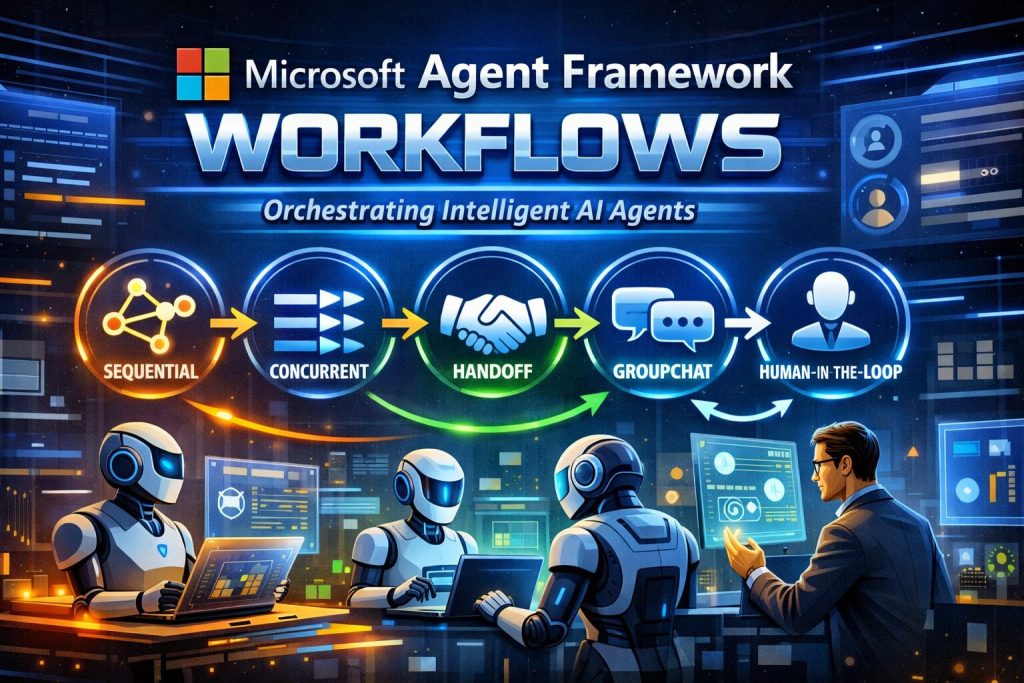
As AI systems evolve from single copilots into coordinated teams of agents, orchestration becomes the difference between experimentation and production success. That’s exactly where Microsoft Agent Framework Workflows shine.
Workflows provide structured coordination patterns that allow multiple agents (and humans) to collaborate predictably, transparently, and safely inside enterprise applications.
If you’re building serious agent-based solutions, especially in environments aligned with Microsoft Foundry, or enterprise APIs, Workflows are the backbone that transforms agents from “chat bots” into digital collaborators.
Let’s explore what workflows are, why they matter, and when to use each orchestration pattern
What Are Microsoft Agent Framework Workflows?
A workflow defines how agents collaborate to complete a task.
Instead of letting agents operate independently and unpredictably, workflows:
 Control execution order Enable specialization across agents Support concurrency and delegation Integrate humans when needed Improve reliability and observability Reduce hallucination risk through structure
Think of workflows as the project manager coordinating your agent team.
- Without workflows, Agents talk randomly.
- With workflows, Agents collaborate intentionally.
Why Workflows Matter in Enterprise AI
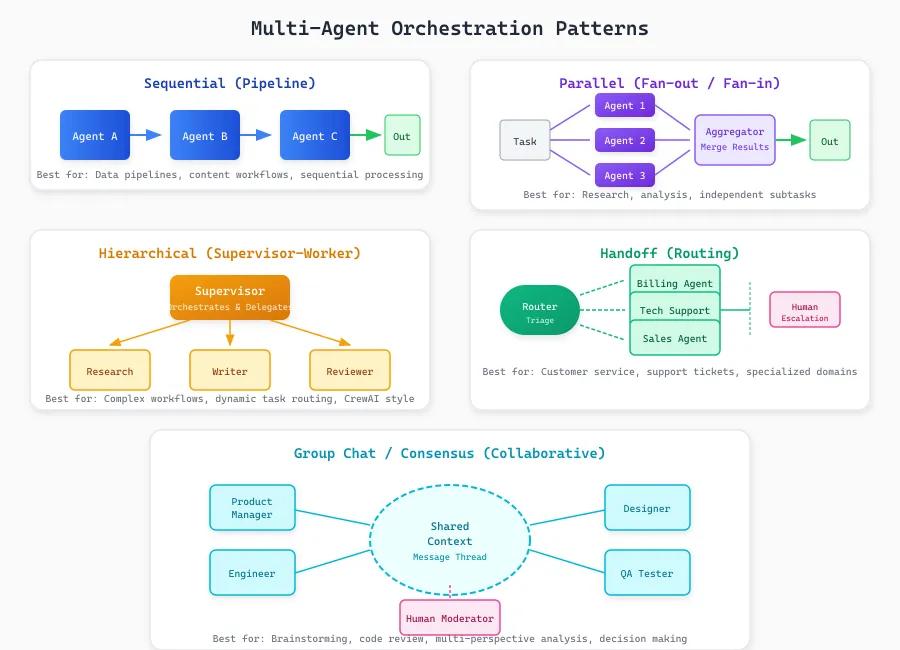
Enterprise agents rarely operate alone.
Real scenarios require:
- planners
- tool users
- validators
- reviewers
- compliance checkers
- data retrieval agents
- human approvals
Workflows enable these roles to interact safely and efficiently.
That’s not a chat. That’s orchestration.
The Five Core Workflow Patterns
Microsoft Agent Framework currently supports five primary workflow orchestration styles:
| Pattern | Purpose | Best For |
|---|---|---|
| Sequential | Step-by-step pipelines | Deterministic processing |
| Concurrent | Parallel execution | Speed & multi-analysis |
| HandOff | Delegation between agents | Specialist routing |
| GroupChat | Collaborative reasoning | Multi-agent intelligence |
| Human-in-the-loop | Approval & intervention | Compliance & governance |
Let’s explore each one:
 Sequential Workflow Pattern
 Sequential Workflow Pattern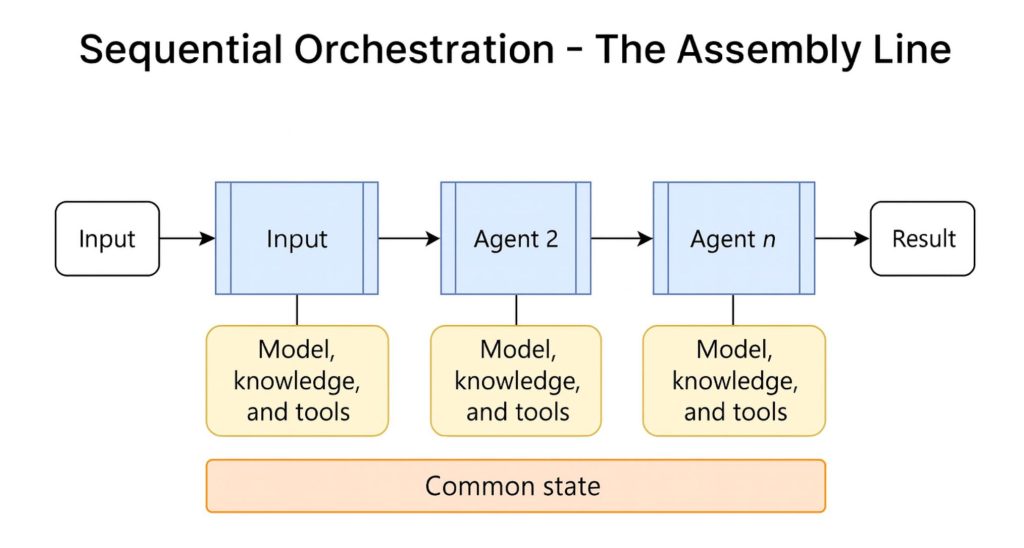
Sequential workflows execute agents one after another.
Each agent receives the output of the previous agent.
When to Use Sequential
Use this pattern when:
 Steps must happen in order Each stage improves the result Deterministic outputs are required Compliance pipelines exist
Concurrent Workflow Pattern
 Concurrent Workflow Pattern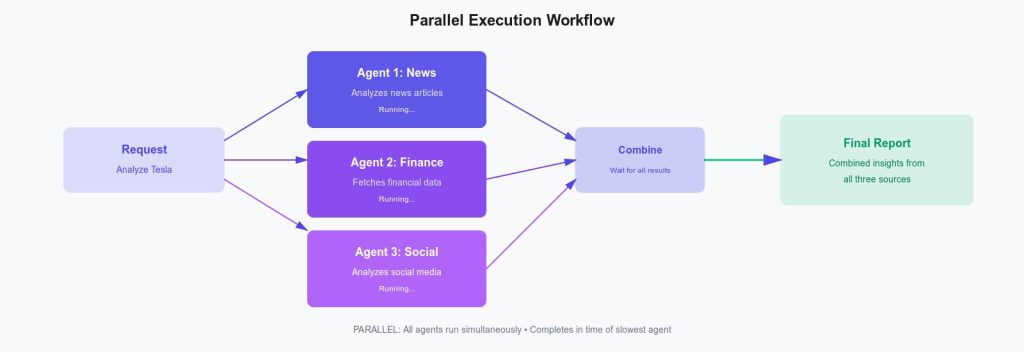
Concurrent workflows execute multiple agents at the same time.
Perfect when tasks are independent.
When to Use Concurrent
Use when:
Speed matters Tasks don’t depend on each other Multi-perspective analysis helps Results must be merged afterward
HandOff Workflow Pattern
 HandOff Workflow Pattern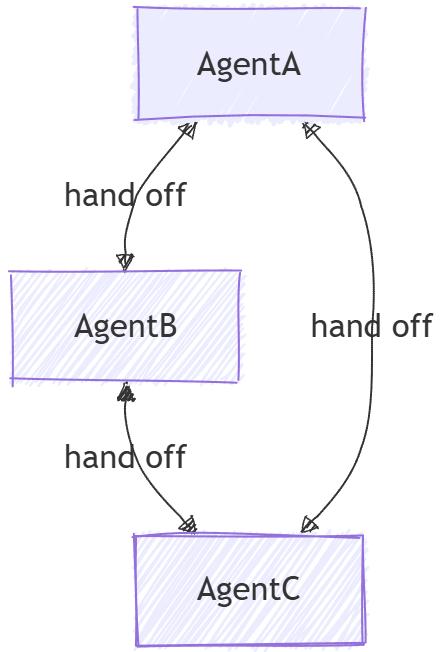
HandOff workflows route execution from one agent to another based on expertise.
Think: intelligent delegation
When to Use HandOff
Best when:
Agents specialize in domains Routing logic is required Intent detection matters Toolsets differ per agent
GroupChat Workflow Pattern
 GroupChat Workflow Pattern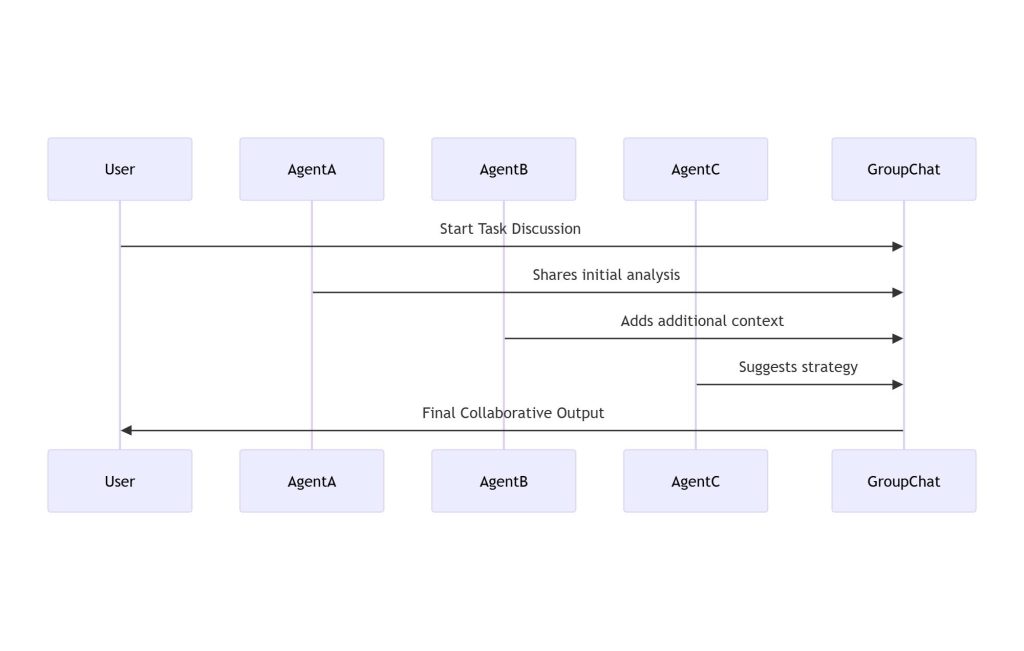
GroupChat workflows allow agents to collaborate dynamically.
Instead of strict pipelines, agents reason together.
This enables:
 brainstorming planning debate consensus building
When to Use GroupChat
Use when:
reasoning improves results exploration is needed solutions are complex creativity matters
Human-in-the-Loop Workflow Pattern
 Human-in-the-Loop Workflow Pattern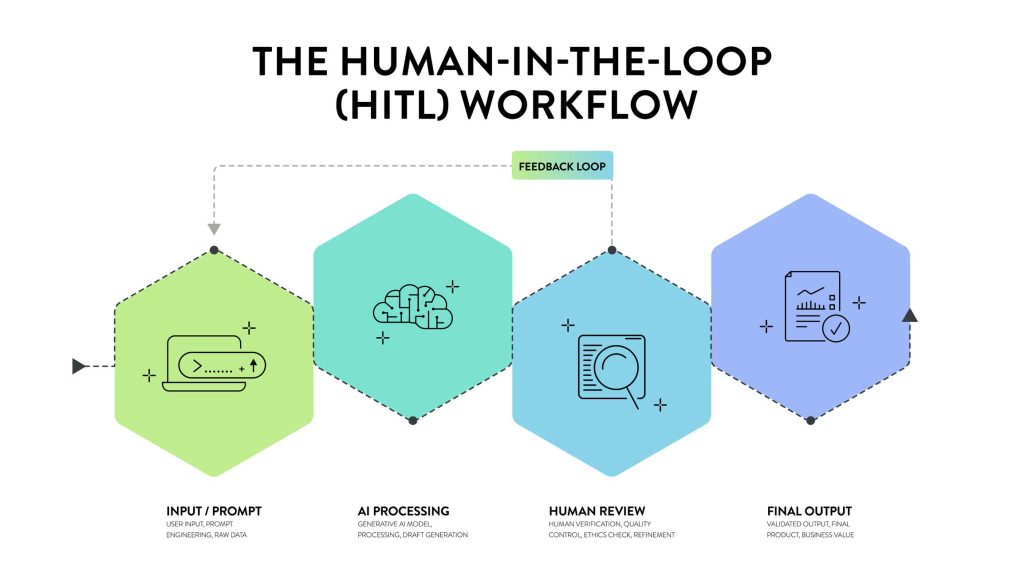
This pattern inserts humans into the orchestration flow.
Essential for enterprise readiness.
When to Use Human-in-the-Loop
Critical when:
compliance approval required legal oversight needed financial risk exists safety validation required trust must be enforced
Why Workflows Are the Future of Agent-Based Systems
The biggest misconception about agents today is That People think agents are single, intelligent assistants. In reality, Agents become powerful when they work together.
Microsoft Agent Framework Workflows provide:
structure reliability scalability explainability enterprise safety
They transform agents from experiments into enterprise infrastructure.
And as organizations move deeper into multi-agent architectures with Microsoft Foundry, workflows will become the standard orchestration layer powering next-generation intelligent applications.
The Training Boss stands ready to partner with your organization to help with your Data & AI endeavors. Reach out today.
Also, get up to speed with Microsoft Agent Framework Workflows and how they work in my latest Video course, use the coupon APRIL30 to get 30% off through the month of April 2026.
1 thought on “Demystifying Agent Framework Workflows”
Pingback: Dew Drop – April 15, 2026 (#4647) – Morning Dew by Alvin Ashcraft
Comments are closed.