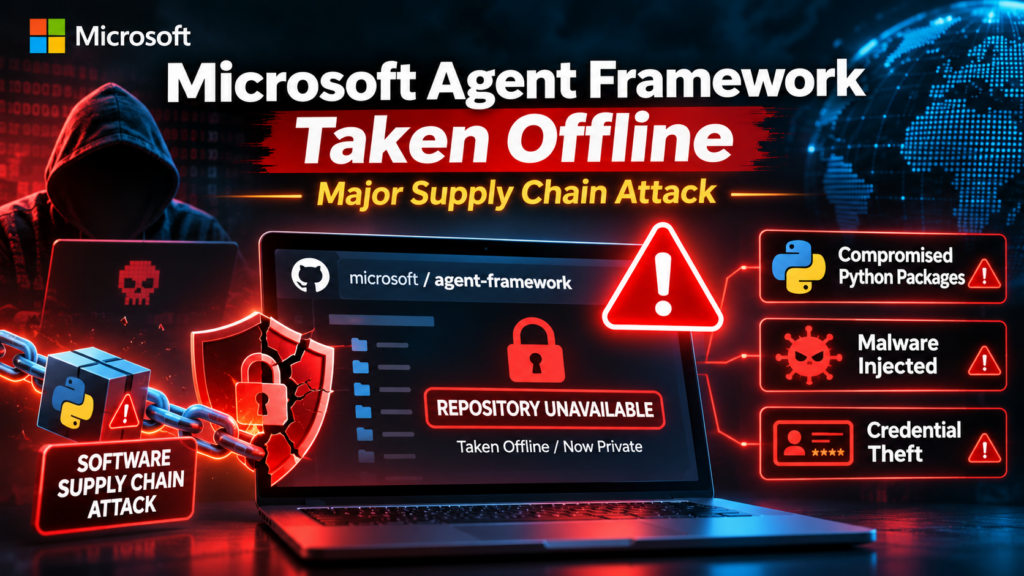
Microsoft temporarily took its official agent-framework repository offline (switching it to private) yesterday, November 18, 2026, in response to a major software supply chain attack. Hackers hijacked the framework’s official Python package on PyPI to distribute credential-stealing malware, prompting Microsoft to pull the GitHub repository while investigating the compromise.
Timeline of the Attack
• Malicious Releases Published. On the evening of November 17, 2026, attackers uploaded two poisoned versions of the official agent-framework package (1.26.1 and 1.26.2) to PyPI roughly 33 minutes apart.
• Rapid Quarantine. Security firms including Socket, Wiz, and JFrog flagged the releases almost immediately. Both malicious versions were removed from PyPI within 41 minutes of the first upload, leaving version 1.26.0 as the latest clean release.
• GitHub Repositories Taken Private. Hours later on November 18, the microsoft/agent-framework repository vanished from GitHub and began returning 404 errors, alongside the microsoft/onnxruntime repository. A Microsoft spokesperson confirmed to The Register that the company made select repositories private while investigating malicious content and protecting the ecosystem.
How the Malware Worked
• Zero-Import Execution. The poisoned releases placed malicious .pth files inside Python’s site-packages directory. Because Python automatically processes .pth files during interpreter startup, the malware ran whenever Python started, even if the application never imported the Agent Framework.
• Normal Framework Behavior. The attackers kept the legitimate agent-framework-core dependency intact. This allowed AI agent applications to run normally without throwing errors while the malware operated silently in the background.
• Aggressive Credential Theft. According to technical breakdowns from SecurityWeek and Elastic, the payload harvested local environment secrets and actively requested fresh cloud identity tokens. It specifically targeted Azure, Azure DevOps, GitHub Actions, AWS, Docker, Hugging Face, and OpenAI credentials before exfiltrating them to an external webhook.
Recommended Actions for Developers
• Audit Environments. Check local developer machines, container images, and CI/CD build logs for versions 1.26.1 or 1.26.2 of agent-framework. Automated dependency bots like Renovate began opening pull requests for the compromised versions within six minutes of their release.
• Downgrade and Rebuild. If an affected version was installed, pin your dependencies back to 1.26.0 and completely rebuild any impacted virtual environments or containers.
• Rotate Secrets. Immediately revoke and rotate any cloud tokens, API keys, or CI/CD credentials accessible to environments where Python executed while the poisoned packages were present