Your first AI agent is in a Microsoft Foundry project, and it works. Then Finance wants one. Procurement wants one. Customer Support wants three. Before long, someone asks which agents can send customer data to an external model, why one team used half the available token capacity, and who can disable an agent that’s making the wrong changes in a business system.
Those questions are hard to answer if every team picks its own model endpoints, credentials, and monitoring. They’re also hard to answer if every change has to go through one central team. Microsoft’s AI Citadel Blueprint gives architects a way to set common rules while letting business teams build and operate their own agents.
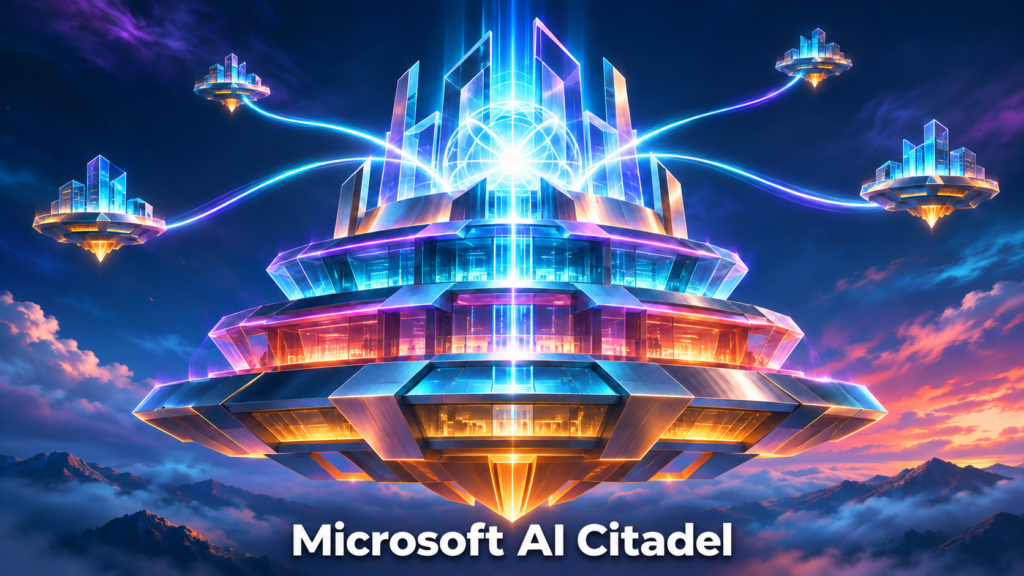
What is Microsoft AI Citadel?
Citadel is Microsoft’s reference architecture for governing AI across an enterprise. It builds on Azure AI Landing Zones and brings together Microsoft Foundry, Azure API Management, Microsoft Agent 365, and the Microsoft security stack. The blueprint describes where to enforce policy, where to run and monitor agents, and who should own each responsibility. Its Gateway Landing Zone includes a deployable accelerator for the shared gateway. Microsoft’s Citadel Blueprint · Azure AI Landing Zones
The architecture has four layers. Each answers a different question an enterprise has to settle before it scales.
| Layer | What it does | Question it answers |
|---|---|---|
| Governance Hub | Uses Azure API Management to route AI requests and enforce policies such as model access, token limits, and content safety on traffic it handles. | Which models can this workload call, and under what limits? |
| Agent Operations | Uses Foundry Agent Service and Foundry Control Plane to run and oversee agents, with traces and evaluations to investigate behavior and quality. | What did the agent do, and how well did it do it? |
| Agent Management | Uses Agent 365 for enterprise inventory and lifecycle oversight, with Microsoft Entra providing identities and access controls for supported agents. | Who owns this agent, what identity does it use, and how do we retire it? |
| Security Foundation | Brings together Entra for access, Defender for threat detection and response, and Purview for data protection and governance. | How do our security and data policies apply across the AI estate? |
The usual deployment is hub-and-spoke. The platform team runs the shared gateway, and workload teams run agents in their own environments. A workload can use a common gateway without sharing another team’s Foundry project, data, or release schedule. That gateway can route to approved backends across providers, including Azure OpenAI, Amazon Bedrock, and Google Gemini. Gateway policies apply to requests that pass through it, so architects still have to control direct access to backends and account for traffic that takes another path. Microsoft’s blueprint and enforcement boundaries · Gateway overview and supported backends · Foundry Control Plane
What’s available today?
As of November 15, 2026, Microsoft’s release notes list the Citadel Governance Hub v1 accelerator as generally available, following its October announcement. The documented hub release is 1.0.2. The GA capabilities include multi-provider model routing, Backend Contracts, Access Contracts, and usage ingestion for reporting and cost allocation. Citadel is the overall architecture, and the GA announcement applies to its Layer 1 accelerator. Microsoft’s October release notes and version table
Several capabilities in that release are still in preview. These include Publish Contracts for tools exposed via Model Context Protocol (MCP) and agents exposed via Agent2Agent (A2A), the Foundry-to-API Management connection and Foundry-hosted A2A publishing documented for Citadel, and the APIM Gateway Upgrade path for existing deployments. Agent 365 separately reached general availability in May 2026, and individual Foundry and Agent 365 capabilities have their own release status. If a production design depends on one of those integrations, verify the status of that specific feature before committing to it. Citadel release notes · Foundry integration guide · Agent 365 availability announcement
Why architects would use it
The part I’d start with is the distinction between a Backend Contract and an Access Contract. The backend contract defines where model requests go, how the gateway authenticates to the provider, and how it routes requests or handles a backend failure. The access contract defines what a consuming application or agent is allowed to use, along with the limits and policies that apply to it. Both can live in version control, where a team can review a new model or access change before deploying it. Microsoft’s Governance Hub architecture
Say Procurement and Customer Support both use a model for summarization. The platform team can onboard approved backends once and expose a model alias. Procurement can have its own model allowlist, token quota, and sensitive-data policy. Support can get a different quota and a backend pool configured for its availability needs. The application teams can keep using the alias when the platform team changes the underlying deployment, provided it preserves the API and behavior those workloads depend on. I’d test failover with each workload’s evaluation set, especially when the fallback changes the model or the region that processes the request. Microsoft’s gateway release notes · Gateway resiliency guidance
What enterprises need before agents can act
Imagine Procurement extends its agent from summarizing supplier quotes to drafting purchase orders. Now four controls matter on the same workflow.
- Least privilege and a named owner. Give the agent an identity scoped to the supplier data and draft-order operation it needs. Assign an owner who can review access and disable the agent when necessary. The purchasing system should enforce the buyer’s approval before an order can be submitted. Gateway access to the model and authorization to commit a purchase are two separate decisions. Microsoft’s Citadel Blueprint · Agent 365 overview
- Data protection at each boundary. Decide what supplier information can leave the workload, which providers and regions can process it, and what goes into logs. The gateway can apply configured content-safety and personally identifiable information (PII) controls to supported traffic. The application and data services still need their own access and retention policies. Citadel Governance Hub architecture
- Evidence you can use in an incident. Use gateway telemetry to see which backend handled a request and whether it was throttled. Use Foundry traces to inspect the agent’s steps, and application audit records to verify who approved the order and what was submitted. An enterprise needs enough evidence to reconstruct the action without routinely storing sensitive prompts and responses. Foundry Control Plane · Citadel observability and governance
- Capacity and cost accountability. Give Procurement its own quota and usage reporting so a sudden spike is visible and one workload is less likely to consume capacity another team needs. Model failover can help with backend outages. The shared gateway also needs capacity planning, monitoring, and a recovery plan of its own. Gateway release notes · Gateway business continuity guidance
Lino’s take
I’d start with one Foundry-backed workload, one approved model backend, and one access contract in a non-production environment. Prove that the gateway denies access to an unapproved model, that the team can trace a failed run, and that Finance can attribute the usage. Then onboard a second team and see whether it can use the same onboarding process with a different identity, quota, and release schedule. Azure Samples Governance Hub accelerator
If you’re planning how to run Foundry agents across several teams, we can help you design the landing zone, define platform ownership, and train the people who will operate it. Contact The Training Boss